1. Special Challenges in Grinding Chemical Raw Materials
- Strong corrosivity
Organic acids, inorganic salts, pigments, dyes, pesticide intermediates, chlorine/sulfur compounds, etc., cause serious corrosion to metal parts.
- Easy oxidation / flammable and explosive
Some powders burn or explode when exposed to air or high temperatures, requiring inert protection and explosion-proof structures.
- Hygroscopic and adhesive
Easy to agglomerate and stick to the wall after grinding, leading to blockage and reduced output.
- High hygiene / high purity requirements
Metal contamination and dust leakage are strictly prohibited; requires dead-angle-free, easy-to-clean, and non-precipitating design.
- Continuous production demand
Equipment must run stably with low failure rate, simple maintenance, and long service life.
2. Core Selection Factor 1: Corrosion Resistance — Material is the First Lifeline
1. Comparison of Common Corrosion-resistant Materials
- 304 Stainless Steel
Application: weakly corrosive, neutral, conventional chemical powders
Features: general-purpose, moderate cost, average rust resistance
- 316L Stainless Steel
Application: weak acid, weak alkali, salt-containing, chlorine-containing materials
Features: resistant to pitting and damp heat, mainstream choice in chemical industry
- 2205 Duplex Steel
Application: moderate corrosion + high wear occasions
Features: high strength, better corrosion resistance than 316L
- Hastelloy / Titanium Alloy
Application: strong acid, strong oxidation, high-temperature corrosive environments
Features: ultimate corrosion protection, relatively high cost
- Engineering Plastic / PTFE Lining
Application: strong acid and alkali, materials where metal ion contamination is prohibited
Features: non-conductive, non-corrosive, non-polluting
- Wear-resistant Ceramics (Alumina / Zirconia)
Application: materials with both high hardness and corrosion
Features: ultra-wear-resistant, no metal precipitation, high chemical stability
2. Selection Recommendations
- General chemical powders → 316L Stainless Steel
- Strong acid and alkali → PTFE Lining / Hastelloy
- High purity, anti-metal contamination → Ceramic Lining + Ceramic Classifier Wheel
- High wear + corrosion → Ceramic + Duplex Steel Combination
3. Core Selection Factor 2: Operational Stability — Ensuring Continuous Production
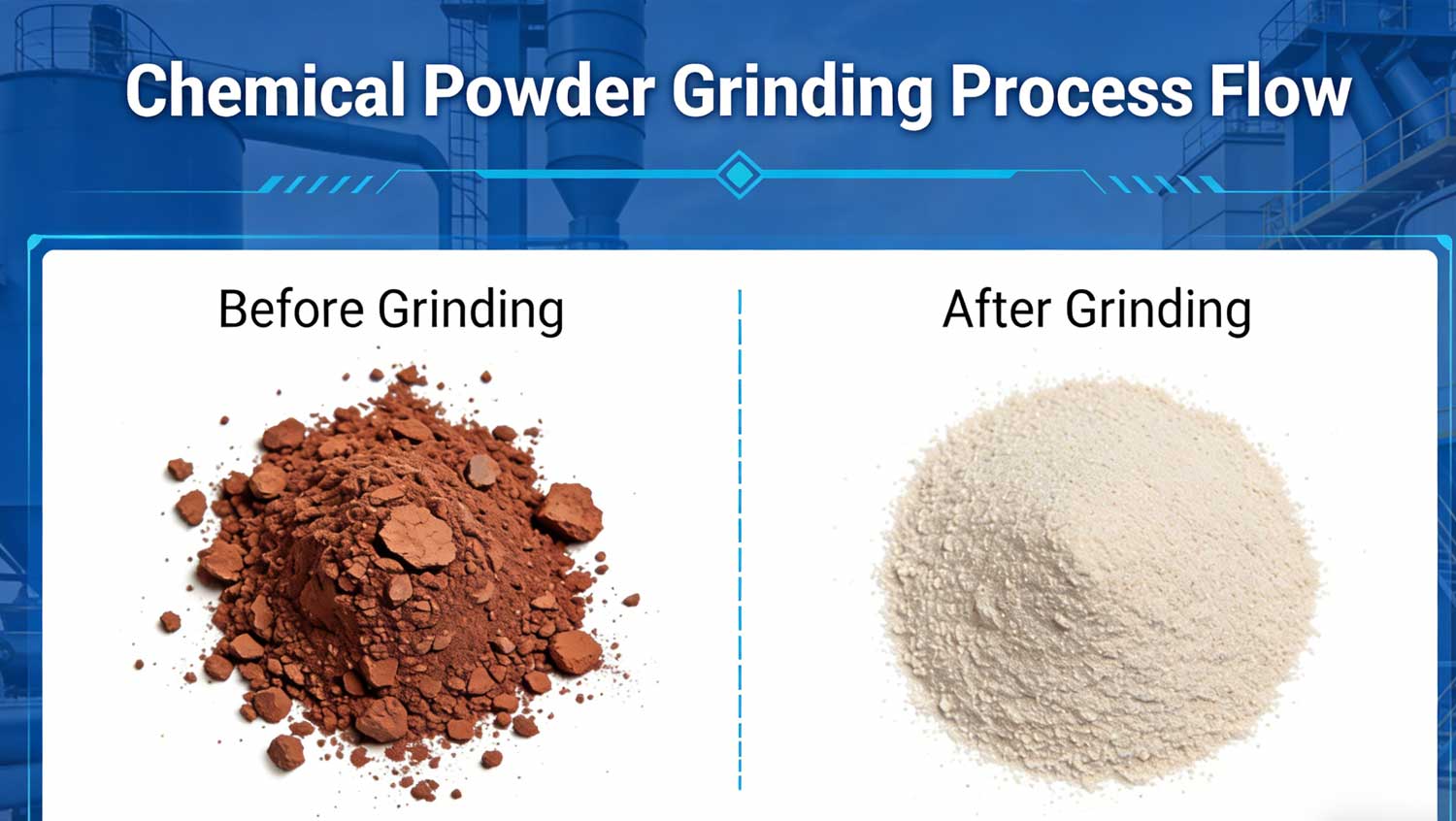
1. Key Structures Ensuring Stability
- Reliable sealing system
- Multi-stage shaft seals and air seals to prevent dust leakage and material entry into the bearing housing
- Stable temperature control
- Low-temperature / temperature-controlled design to avoid melting, denaturation, and explosion caused by temperature rise
- Anti-blocking design
- Smooth inner walls, air sweeping devices, reasonable flow field to reduce wall adhesion
- Shock absorption and low noise
- Stable operation, suitable for long-term 24-hour continuous work
- Easy disassembly and cleaning
- Quick-release structure greatly reduces time for material change, cleaning, and maintenance
2. Direct Benefits of Stability
- Equipment life increased by 2–5 times
- Maintenance costs reduced by more than 50%
- More uniform particle size and higher product qualification rate
- Significantly lower risk of safety accidents
4. Recommended Grinding Solutions for Different Chemical Materials
1. Pigments, Dyes, Color Powders
- Characteristics: easy adhesion, easy contamination, pure color required
- Recommendation: 316L / Ceramic-lined Jet Mill / Mechanical Ultra-fine Grinding Machine
- Key points: anti-wall adhesion, no metal contamination, easy cleaning
2. Pesticide Intermediates, API Chemicals
- Characteristics: corrosive, high purity requirements
- Recommendation: 316L / Ceramic Inert-protected Ultra-fine Grinding System
- Key points: GMP hygiene, corrosion protection, closed and dust-free
3. Inorganic Salts, Chemical Fillers
- Characteristics: high hardness, high wear, certain corrosiveness
- Recommendation: Ceramic-lined Jet Mill + Wear-resistant Classifier Wheel
- Key points: wear resistance, long service life, high stability
4. Resins, Plastics, Rubber Additives
- Characteristics: heat-sensitive, adhesive, easy to soften
- Recommendation: Cryogenic Ultra-fine Grinding Equipment
- Key points: temperature control, anti-adhesion, anti-melting
5. Flammable and Explosive Powders
- Characteristics: flammable, explosive, explosion-proof required
- Recommendation: Inert Gas Closed-loop Grinding System
- Key points: nitrogen protection, explosion-proof motor, explosion-proof certification, anti-static
5. 5-step Final Selection Method for Chemical Ultra-fine Grinding Equipment
- Confirm material corrosivity: strong acid / weak acid / neutral / strong oxidation
- Confirm explosion-proof and anti-oxidation needs: whether nitrogen protection is required
- Confirm purity requirements: whether trace metal precipitation is allowed
- Confirm capacity and particle size: mesh/μm, output kg/h
- Confirm working conditions: continuous production, humidity, temperature, on-site layout
6. Summary
- Corrosion resistance: determines equipment life and whether material is contaminated.
- Stability: determines whether safe and continuous long-term production is possible.