

How it works
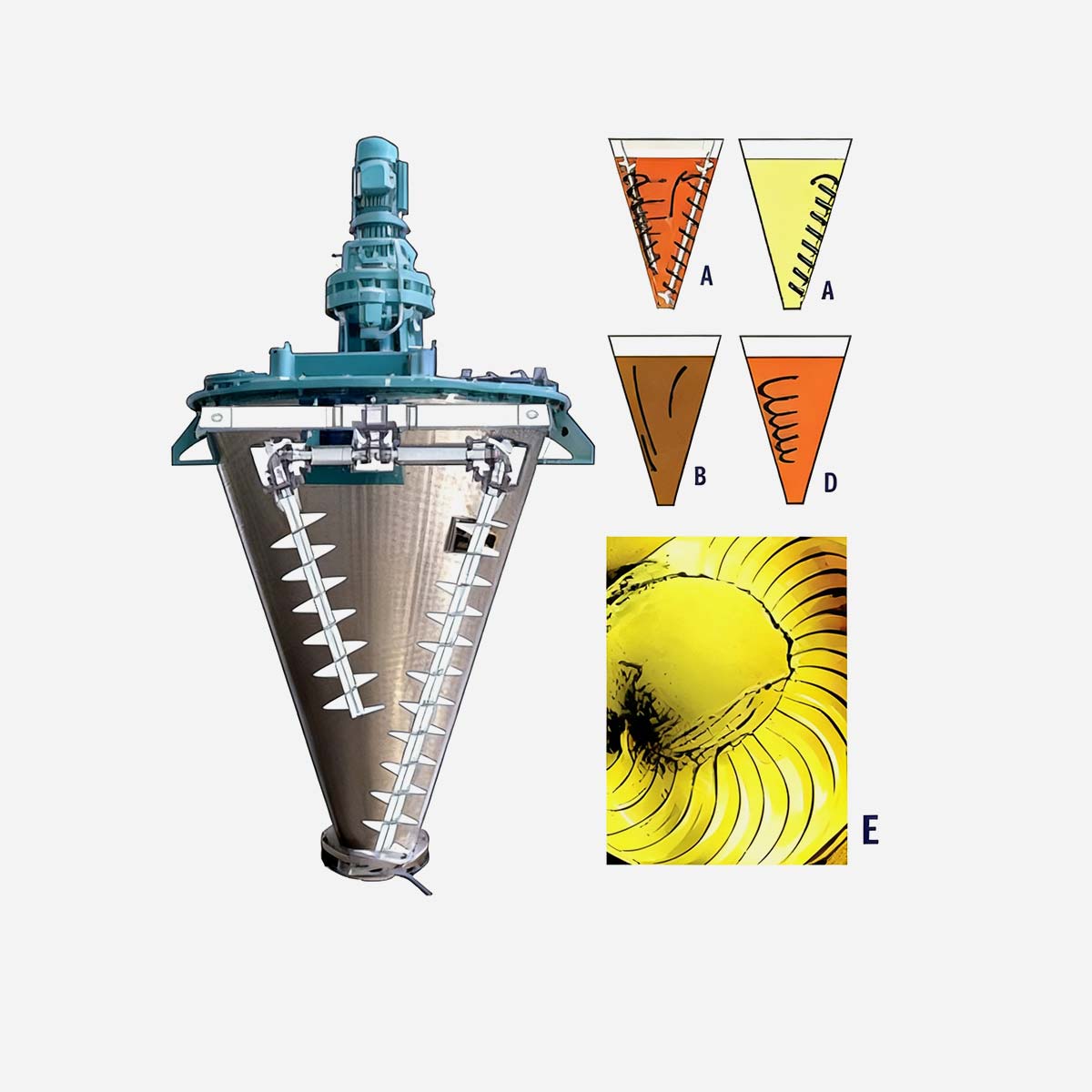
The JDSH cantilever asymmetric double-helix conical mixer uses the rapid rotation of two asymmetric spirals to lift the material upward and form two asymmetric spiral material flows from bottom to top along the cylinder arm. The spiral revolution driven by the rotating arm allows the material outside the spiral to enter the stud envelope to varying degrees. Part of the material is lifted by the stud, and the other part of the material is thrown out of the stud, thereby achieving continuous renewal and diffusion of the material in the entire circumference. The two materials lifted to the upper part merge into the central concave hole to form a downward material flow, which supplements the bottom hole, thus forming a convection cycle. Due to the combination of the above movements, the material is evenly mixed in a relatively short time, and the mixing degree is relatively high.
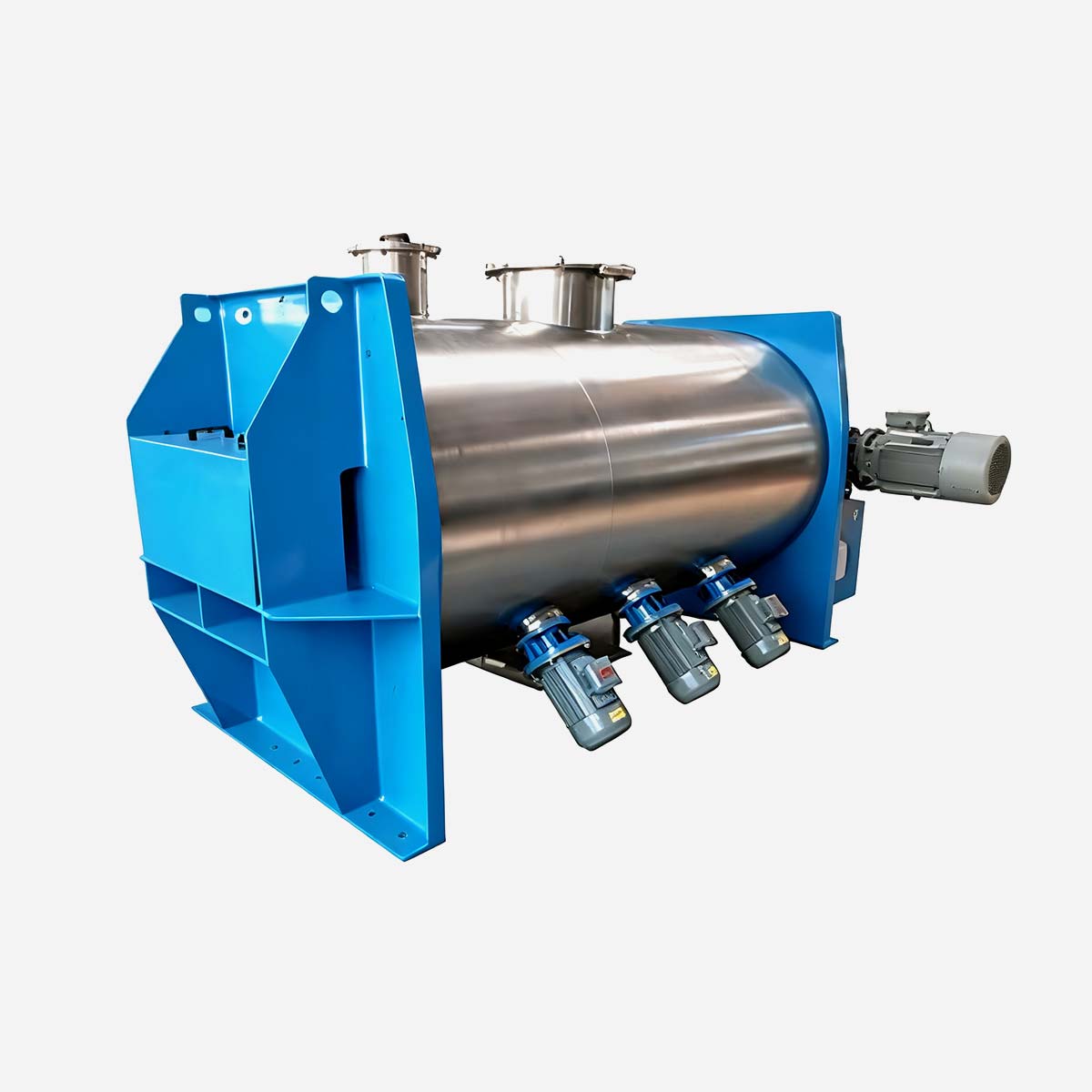
The JLDH coulter mixer consists of a horizontal cylindrical barrel, a single shaft with a pear head agitator, a high-speed flying knife, a top opening, a bottom leg and a transmission unit. The coulter mixer rotates to drive the material to move radially; the high-speed flying knife breaks up the material; the material is evenly mixed under the action of the pear head agitator and the high-speed flying knife.

Performance and features
JDSH Model Structural Features: Conical Cylinder + Cantilever Double Screws
Adopts conical cylinder and cantilever asymmetric double-screw design, with no mixing dead ends, complete bottom discharge and low material residue. It has excellent sealing performance, supports vacuum feeding, and strong structural adaptability, providing a stable hardware foundation for efficient mixing.
JLDH Model Mixing Effect: Dual Action + Uniform Breaking
Horizontal cylindrical cylinder equipped with single-shaft plow blades and high-speed flying knives. Plow blades drive radial material movement, while flying knives quickly break agglomerates. Under dual actions, materials achieve high mixing uniformity, efficiently handling viscous, slightly agglomerated and fibrous materials with outstanding mixing efficiency.
Differences in Applicable Needs: Precisely Matching Different Mixing Scenarios
The JDSH model focuses on high-uniformity mixing needs, suitable for materials with large differences in specific gravity and particle size. The JLDH model is more suitable for agglomerate-breaking and large-batch processing requirements, flexibly meeting diverse material mixing demands.
Core Advantage Comparison: Complementary Adaptation to Diverse Needs
The JDSH model features low residue and high uniformity as core advantages, with no stratification during mixing. The JLDH model integrates stirring and breaking functions, offering simple maintenance and convenient feeding. The two models complement each other, covering core demands of different mixing scenarios.
Technical Parameters
| Parameters / Model JLDH | 100 | 300 | 500 | 1000 | 2000 | 3000 | 4000 | 6000 | 10000 | 15000 |
|---|---|---|---|---|---|---|---|---|---|---|
| Full volume (L) | 100 | 300 | 500 | 1000 | 2000 | 3000 | 4000 | 6000 | 10000 | 15000 |
| Working volume (L) | 40~60 | 120~180 | 200~300 | 400~600 | 800~1200 | 1200~1800 | 1600~1800 | 2400~3600 | 4000~6000 | 6000~9000 |
| Speed (rpm) | 80 | 80 | 80 | 80 | 60 | 60 | 60 | 40 | 20 | 15 |
| power (kW) | 2.2 | 4 | 5.5 | 11 | 18.5 | 22 | 30 | 37 | 55 | 75 |
| Dimensions (mm) | 1600×680×800 | 2000×800×1100 | 2600×1000×1200 | 3000×1250×1300 | 3600×1500×1700 | 4500×1600×1800 | 4500×1600×2000 | 5000×2300×2500 | 5900×2300×2500 | 6400×2600×2850 |
| Parameters / Model JDSH | 100 | 300 | 500 | 1000 | 2000 | 3000 | 4000 | 6000 | 10000 | 15000 |
|---|---|---|---|---|---|---|---|---|---|---|
| Full volume (L) | 100 | 300 | 500 | 1000 | 2000 | 3000 | 4000 | 6000 | 10000 | 15000 |
| Working volume (L) | 40~60 | 120~180 | 200~300 | 400~600 | 800~1200 | 1200~1800 | 1600~1800 | 2400~3600 | 4000~6000 | 6000~9000 |
| Speed (rpm) | Revolution 2 / Rotation 108 | Revolution 2 / Rotation 108 | Revolution 2 / Rotation 108 | Revolution 2 / Rotation 60 | Revolution 2 / Rotation 60 | Revolution 2 / Rotation 60 | Revolution 2 / Rotation 60 | Revolution 2 / Rotation 60 | Revolution 2 / Rotation 60 | Revolution 2 / Rotation 60 |
| power (kW) | 1.1 | 2.2 | 3 | 4 | 5.5 | 7.5 | 11 | 15 | 22 | 30 |
| Dimensions (Φ×H,mm) | 700×1500 | 900×2000 | 1100×2300 | 1600×2700 | 1900×3400 | 2100×3700 | 2400×4400 | 2700×4900 | 3000×5600 | 3400×6600 |
Note: The production capacity is closely related to the particle size, specific gravity, hardness, moisture and other indicators of the raw materials.
The above parameters are for reference only, please consult our engineers for details.