Compared with other grinding mills, it can obtain greater acceleration and grinding kinetic energy,and the feeding particle size is larger (≤50mm, the material can be added only passing through the primary grinding equipment).

Compared with other grinding mills, it can obtain greater acceleration and grinding kinetic energy,and the feeding particle size is larger (≤50mm, the material can be added only passing through the primary grinding equipment).

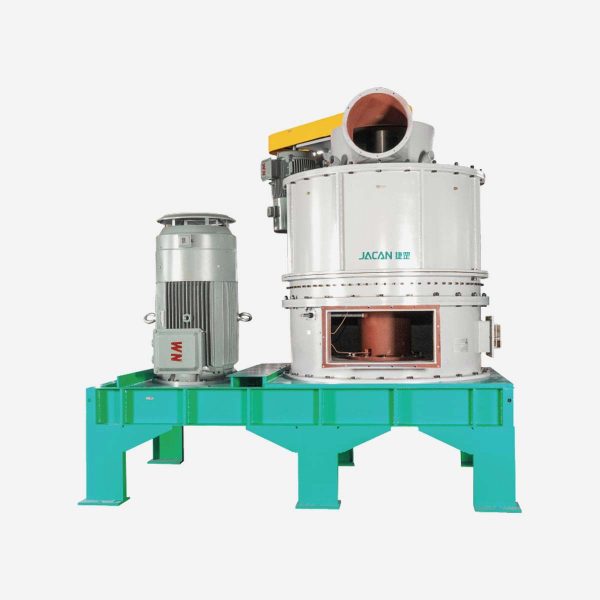
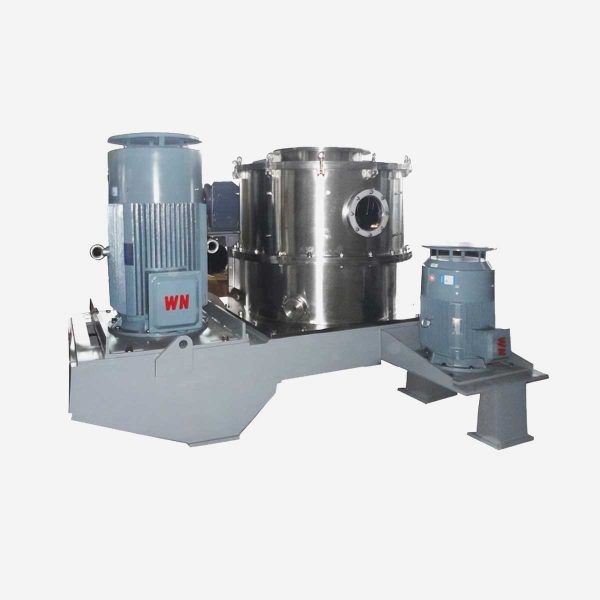
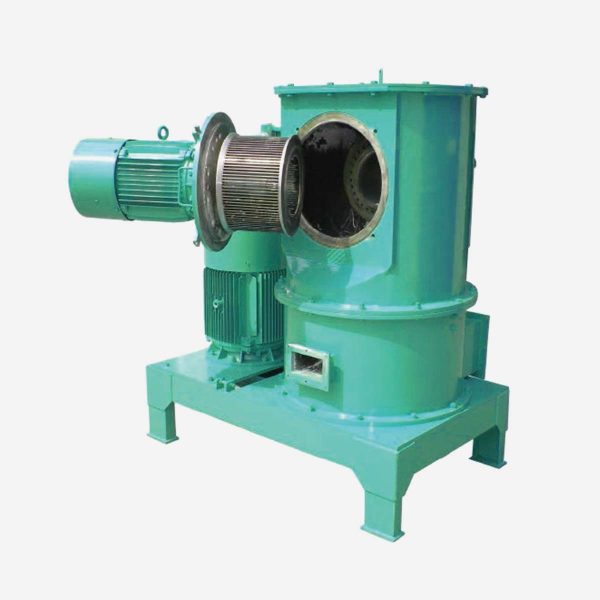
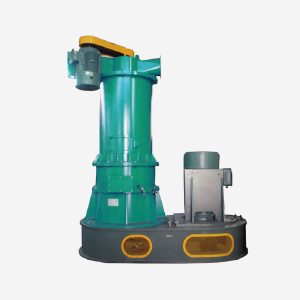
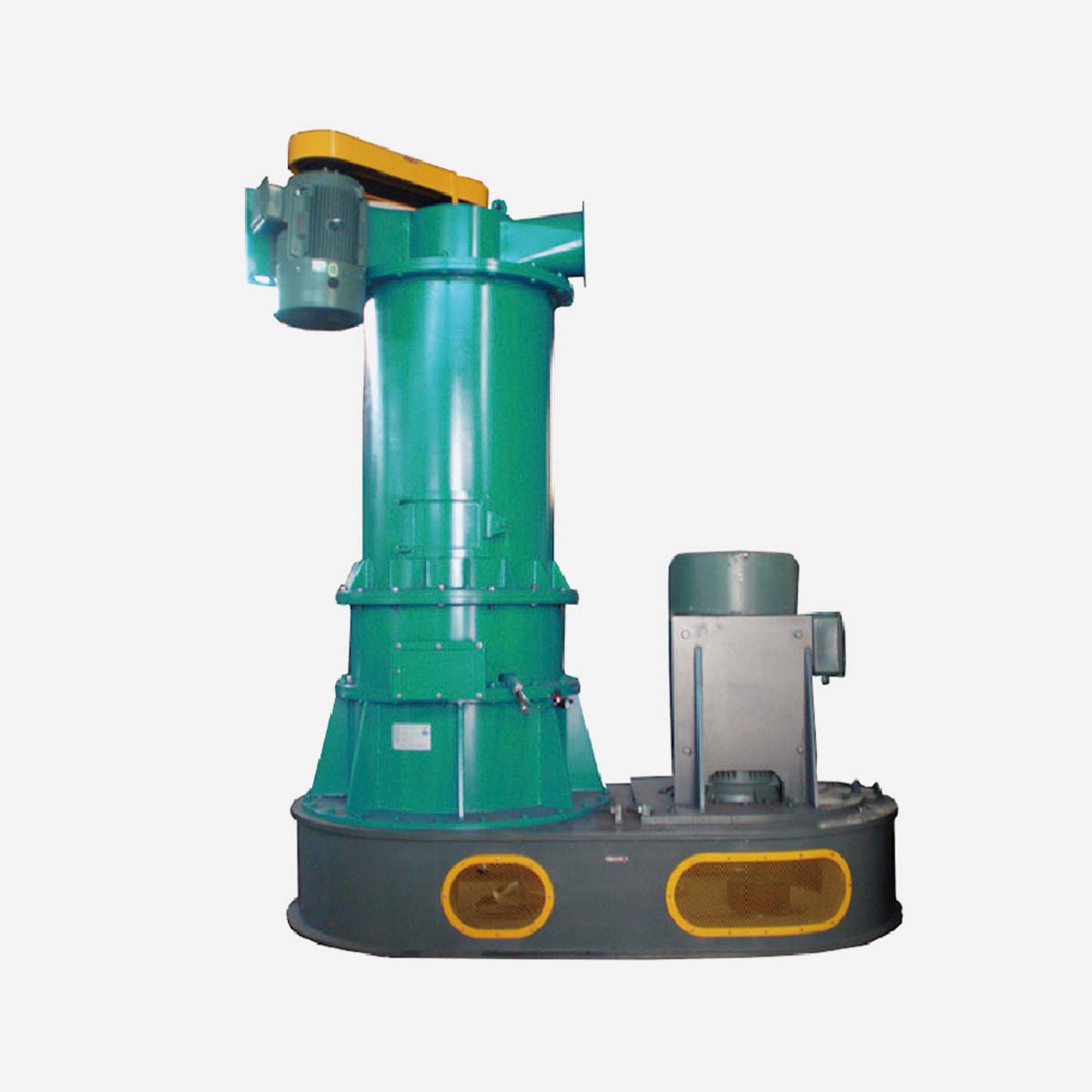
The inner cavity of the machine body is cylindrical, the upper section is an air classifier and the lower section is an ultra-fine grinding mill. The grinding chamber is composed of a grinding disc and a grinding block, which is used to crush materials into fine powder. The grading chamber is composed of a classifying impeller, which can separate fine powder into two types of particle specifications: qualified and unqualified. The qualified particles are discharged through the discharge pipe and collected by the cyclone collector. Unqualified particles will return to the grinding chamber along the inner wall of the cavity and continue shattered.
The grinding disc and classifying impeller are driven by their respective driving systems, the speed of the classifying impeller is adjustable to meet different size requirements. The spiral feeding system is located on the inner wall of the machine and is used to send materials uniformly into the grinding chamber, the amount can be adjusted by rotational speed.

Equipped with an extended classification chamber, crushed materials undergo full gravity classification before entering the centrifugal classification zone. The dual-classification process enhances precision, resulting in better finished product fineness and significant advantages in large particle control, ensuring particle size uniformity.
For materials with high moisture content, the extended classification chamber creates an elongated conveying path. As materials travel a longer distance within the chamber, they make full contact with the internal air flow, enabling moisture evaporation during the classification process and achieving excellent drying performance.
Adopting the "stone-on-stone" crushing principle, the equipment crushes materials through inter-particle impact and grinding, avoiding morphological damage. When processing needle-like materials, their original structure is preserved, and the finished product can achieve an aspect ratio of 15:1, meeting special morphological requirements.
The core components (crushing blocks and gear rings) are made of composite wear-resistant materials, featuring excellent impact and wear resistance. This effectively reduces component wear, significantly extends the service life, and lowers equipment maintenance costs and frequency.
| Parameters / Model JCSM-L | 280 | 350 | 450 | 630 | 780 | 1000 | 1350 |
|---|---|---|---|---|---|---|---|
| Grinding motor power (kW) | 11 | 22 | 45 | 75~90 | 130~160 | 200~250 | 250~355 |
| Classification motor power (kW) | 2.2 | 4 | 11 | 18.5 | 30 | 37~45 | 45~75 |
| Particle size(μm) | 10~100 | 10~100 | 10~100 | 8~120 | 8~120 | 1~150 | 1~150 |
| Output (kg/h) | 0.05~0.6 | 0.1~1.2 | 0.25~3.0 | 0.5~6.0 | 1.0~15.0 | 1.5~25 | 2.5~40 |
Note: The production capacity is closely related to the particle size, specific gravity, hardness, moisture and other indicators of the raw materials.
The above parameters are for reference only, please consult our engineers for details.