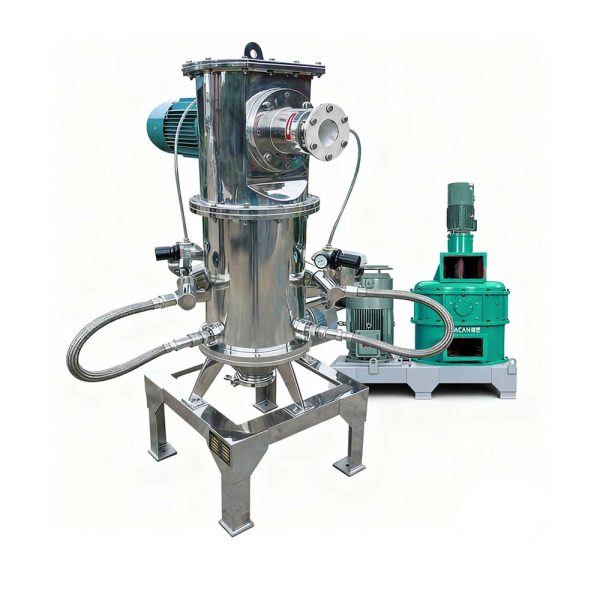
I. Working Principle: Core Differences Determine Application Scenarios
1. Jet Mill: Using “Air” as a Blade for High-Speed Impact Crushing
A jet mill (also known as a fluid energy mill) utilizes high-speed air flow (compressed air or inert gas) to accelerate materials to supersonic speeds (usually 300-1000m/s). Materials are crushed in the crushing chamber through high-speed collisions and shearing between particles, as well as impacts between particles and the chamber wall.
Its core power comes from the kinetic energy of the air flow, with almost no mechanical contact during the crushing process, thus minimizing pollution risks.
2. Impact Mill: Using “Machinery” as Force for Mechanical Impact Crushing
Impact mills (including hammer mills, cage mills, etc.) drive mechanical components (hammerheads, impellers, rotor blades, etc.) to rotate at high speed via motors. They crush materials through mechanical impact, shearing and grinding forces generated by the rotating components.
The crushing effect depends on the rotational speed and material of the mechanical components. Direct contact between components and materials may cause a certain degree of wear and pollution.
II. Applicable Materials: Targeted Selection Based on Hardness and Characteristics
Materials Suitable for Jet Mills:
- High-hardness materials: Diamond, silicon carbide, corundum, ceramics, etc. (Mohs hardness ≥7), which are difficult to crush with impact mills and tend to wear equipment.
- Heat-sensitive materials: Pharmaceutical raw materials, food additives, plastics, etc. Low-temperature jet mills can be cooled with liquid nitrogen to prevent material deterioration due to high temperatures.
- Materials requiring high purity: Electronic materials, rare metal powders, etc. No mechanical contact prevents impurity contamination.
- Materials needing ultra-fine crushing: Powders requiring micron-level (1-50μm) or even nano-level particle sizes, such as coatings and catalysts.
Materials Suitable for Impact Mills:
- Medium and low-hardness materials: Ores (limestone, gypsum), chemical fertilizers, feed, traditional Chinese medicines, etc. (Mohs hardness ≤6).
- Tough materials: Fibrous materials (wood, straw), rubber, etc., which are more easily crushed by mechanical impact and shearing force.
- Primary or secondary crushing needs: Finished products with particle size requirements above 100μm, such as construction sand and primary ore crushing.
III. Crushing Effect: Comparison of Particle Size, Purity and Uniformity
| Indicators | Jet Mill | Impact Mill |
|---|---|---|
| Finished particle size | Finer (down to below 0.5μm) with narrow particle size distribution | Coarser (usually ≥50μm) with wider particle size distribution |
| Purity | No mechanical wear, high purity, suitable for high cleanliness requirements | Possible impurity introduction due to mechanical component wear, lower purity |
| Particle shape | Smooth particle surface and regular shape (spherical or near-spherical) | Irregular particle shape, may have edges, corners or fibrous forms |
| Temperature rise control | Can be equipped with low-temperature systems (e.g., liquid nitrogen), suitable for heat-sensitive materials | Significant heat generation from mechanical friction, prone to material heating and deterioration |
IV. Energy Consumption and Cost: Short-Term Investment vs Long-Term Benefits
1. Energy Consumption Comparison
- Jet Mill: Relies on high-pressure air flow drive, resulting in higher energy consumption (especially for ultra-fine crushing). The unit product power consumption is usually 2-5 times that of impact mills.
- Impact Mill: Crushes directly through mechanical force, with lower energy consumption, suitable for large-scale primary crushing scenarios.
2. Equipment and Maintenance Costs
- Jet Mill: Complex equipment structure (including air compressors, classifiers, etc.) leads to high initial investment. However, there are few wearing parts (mainly nozzles), resulting in low maintenance costs.
- Impact Mill: Simple equipment structure with low initial investment. However, components such as hammerheads and liners are prone to wear and need regular replacement, leading to higher long-term maintenance costs.
V. Production Efficiency: Balancing Batch Production and Precision
- Jet Mill: Single equipment has a small processing capacity (usually tens of kilograms to several tons per hour), suitable for small-batch, high-precision powder production.
- Impact Mill: Large processing capacity (up to tens of tons per hour), suitable for large-scale industrial production, but the finished product has poor particle size uniformity.
VI. How to Choose? 3 Steps to Lock in the Optimal Equipment
- Check material characteristics: Prioritize jet mills for high-hardness, heat-sensitive, and high-purity materials; choose impact mills for medium and low-hardness materials and large-volume primary crushing.
- Check finished product requirements: Select jet mills for ultra-fine (≤50μm) and narrow particle size distribution needs; choose impact mills when particle size requirements are not strict (≥100μm).
- Calculate comprehensive costs: Choose impact mills if short-term budget is limited and output is large; opt for jet mills for long-term quality pursuit and low maintenance costs.