In an ultrafine grinding production line, supporting conveyor equipment is a key link connecting the ultrafine grinder with subsequent processes such as classification, mixing, and packaging, directly determining production efficiency, powder purity, and equipment operation and maintenance costs. Many users fall into confusion when selecting supporting conveyor equipment after purchasing an ultrafine grinder — among the mainstream belt conveyors and screw conveyors on the market, how to choose the right one? Choosing the right one can avoid problems such as powder leakage, blockage, and pollution; choosing the wrong one will not only drag down the production capacity of the entire production line but also increase additional losses. Combining the characteristics of the ultrafine grinding industry, material properties, and production scenarios, this article will teach you step by step how to select the right supporting conveyor equipment, avoid selection mistakes, and achieve efficient production.
I. Grasp the Core First: 3 Key Premises for Supporting Conveying of Ultrafine Grinding
The powder after ultrafine grinding is mostly micron-level or submicron-level, with characteristics such as fine particle size, uneven fluidity, and some materials being prone to moisture absorption, dust generation, or corrosion. Therefore, the selection of supporting conveyor equipment must first meet 3 core requirements, which are the basis for selection:
① Dust and Leakage Control: Reduce powder dust generation, avoid environmental pollution and material loss, and ensure production safety; ② Powder Protection and Blockage Prevention: The conveying process is stable, without damaging the original particle size of the powder, and eliminating blockage and material adhesion problems; ③ Adaptability: Comply with material characteristics, production scale, and workshop layout, balancing efficiency and practicality.
At present, belt conveyors and screw conveyors are the two most widely used methods in ultrafine grinding production lines. The adaptation scenarios of the two are significantly different. Mastering their core selection logic can quickly match your own needs.
II. Mainstream Selection: Belt Conveyor vs. Screw Conveyor, Core Differences and Selection Logic
There is no absolute advantage or disadvantage between belt conveyors and screw conveyors; the core is “adapting to your own scenario”. Below, we will analyze the applicable situations of both from key selection dimensions to help you quickly find the right fit.
(I) Belt Conveyor: Suitable for “Large-Scale, Universal” Scenarios
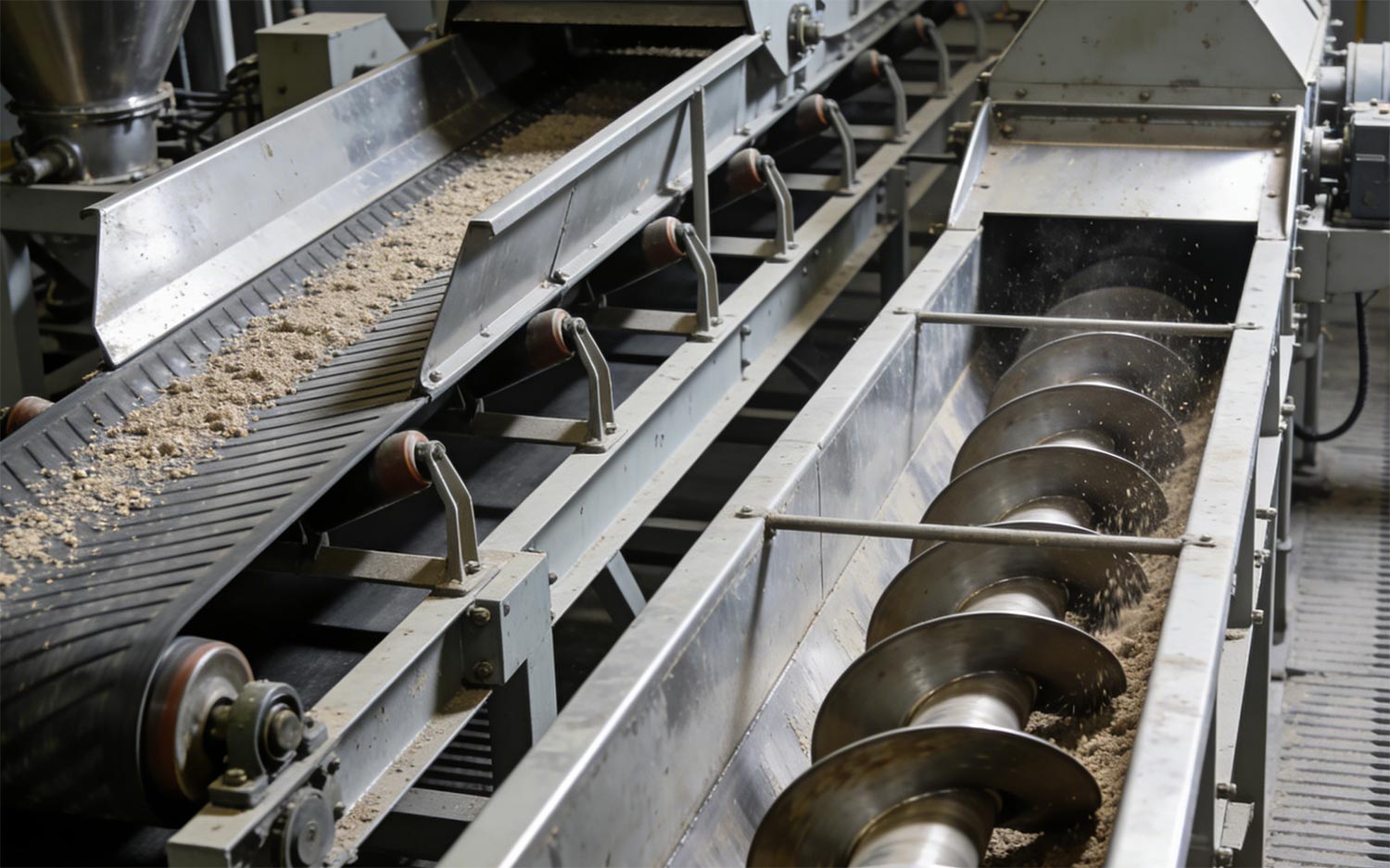
Belt conveyors realize powder conveying through the continuous operation of the belt. Their core advantages are large conveying capacity, adjustable speed, low energy consumption, and simple maintenance. They are suitable for most ultrafine grinding scenarios without special requirements and are the first choice for large-scale production.
[Selection Key: If one or more of the following scenarios are met, prioritize belt conveyors]
1. Large Production Scale: The daily output of the ultrafine grinder is more than 10 tons, and long-distance (5-50 meters) powder conveying is required. For example, after batch grinding of minerals (quartz sand, limestone), chemical raw materials, etc., they need to be conveyed to the classifier and storage area. The large capacity of the belt conveyor can avoid frequent shutdowns for feeding and improve production efficiency.
2. Universal Material Properties: The powder is non-corrosive, low in moisture absorption, and non-caking, such as talcum powder, calcium carbonate, food-grade jujube powder, and traditional Chinese medicine fine powder with no strong moisture absorption. Such materials are not easy to stick to the wall, and belt conveyors are not easy to block, which can protect the powder particle size from being damaged.
3. Permissible Workshop Conditions: The workshop has sufficient space, and open or semi-open conveying can be adopted (with supporting dust removal equipment), which is convenient for observing the conveying status and easier for later cleaning and maintenance; if there is slight dust generation, adding a dust cover can meet environmental protection requirements.
4. Multi-Equipment Linkage: The ultrafine grinder, classifier, packaging machine, and other equipment are scattered. It is necessary to flexibly adjust the conveying direction to realize continuous linkage of “grinding → classification → packaging” and reduce manual transfer.
[Selection Notes]
① Ultrafine powder is prone to dust generation; priority should be given to sealed belt conveyors, with dust covers and dust collection ports added, used in conjunction with pulse dust removal equipment; ② The conveying angle should be controlled at ≤15° to avoid powder sliding and affecting efficiency; ③ For the food and pharmaceutical industries, food-grade and pharmaceutical-grade belts (stainless steel, food-grade rubber) should be selected to meet GMP compliance requirements.
(II) Screw Conveyor: Suitable for “Small and Medium-Scale, Special Demand” Scenarios
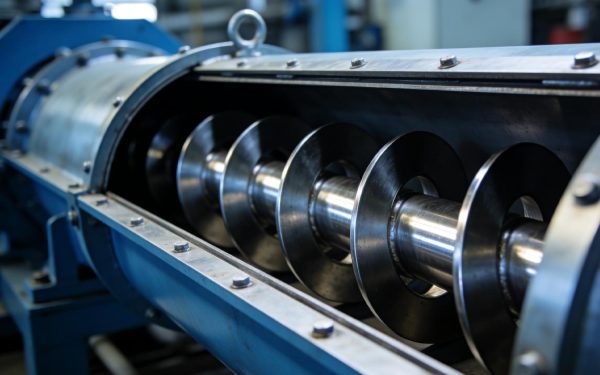
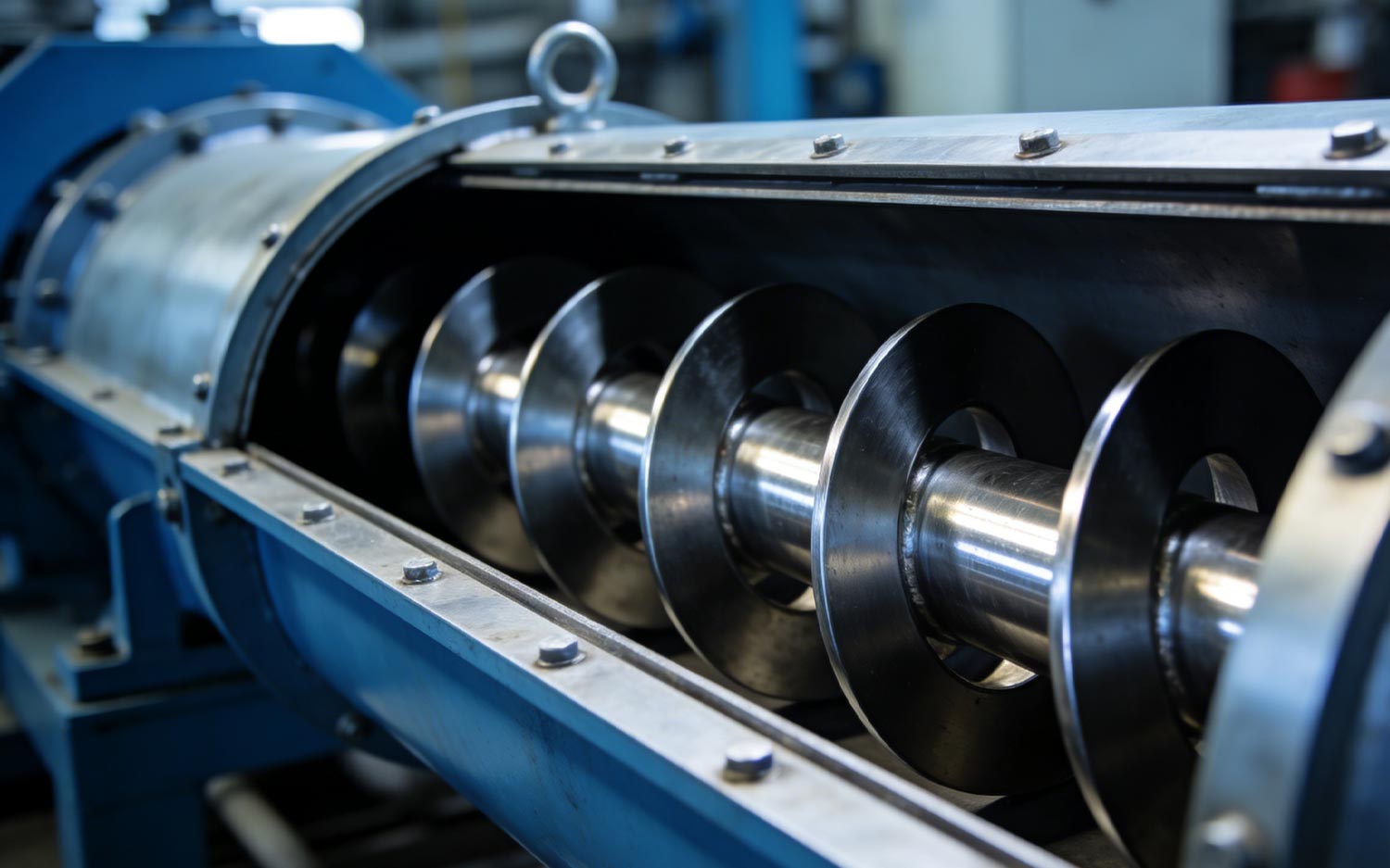
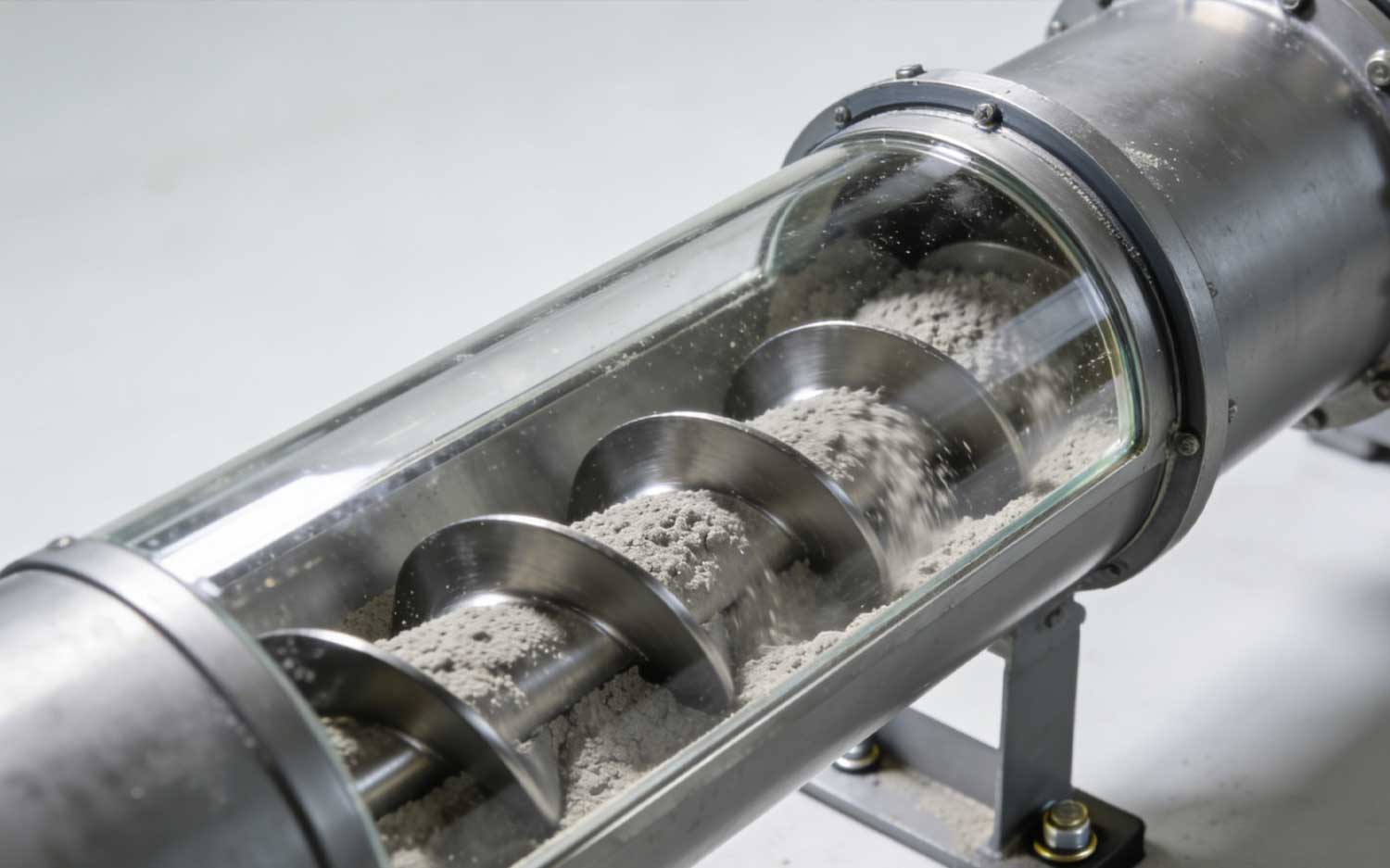
Screw conveyors push powder through the rotation of screw blades. Their core advantages are good airtightness, small floor space, and the ability to convey vertically/inclined. They are suitable for small and medium-sized production lines, closed environments, or special material conveying, with higher accuracy.
[Selection Key: If one or more of the following scenarios are met, prioritize screw conveyors]
1. Small Production Scale: The ultrafine grinder is for laboratory use or has a daily output of 1-5 tons, with short-distance (1-5 meters) conveying required. For example, university scientific research, small-batch food processing, and pharmaceutical pilot tests. The workshop space is limited, and the screw conveyor has a small floor space and high accuracy, which is suitable for small-capacity needs.
2. Special Material Requirements: The powder is prone to moisture absorption, dust generation, or slight corrosion, such as traditional Chinese medicine extract fine powder, chemical corrosive powder (such as soda ash, Glauber’s salt), and moisture-absorbing food powder (such as milk powder, protein powder). The closed structure of the screw conveyor can prevent moisture absorption and dust generation, and avoid equipment corrosion (corrosion-resistant material blades can be selected).
3. Vertical/Large-Angle Conveying Needs: There is a height difference between the ultrafine grinder and the classifier, storage equipment (for example, the grinding equipment is on the ground, and the classifier is on the second floor). The screw conveyor can realize vertical or ≤45° inclined conveying without the need to build an additional platform, saving space.
4. Need for Precise Metering: The powder needs to be accurately conveyed to mixing and metering equipment, with high requirements for proportioning (such as cosmetic powder, electronic material powder). The screw conveyor can control the conveying volume by adjusting the speed, with small error, meeting the needs of precise batching.
[Selection Notes]
① Avoid conveying ultrafine powder that is easy to agglomerate and has high viscosity (such as traditional Chinese medicine powder with high humidity) to prevent blade sticking and blockage; ② Select equipment with small blade gaps to reduce powder residue and facilitate cleaning; ③ For corrosive materials, select corrosion-resistant materials such as stainless steel and polytetrafluoroethylene to extend equipment service life.
III. Quick Selection Comparison Table: Easy to Understand, No Mistakes
To facilitate your quick selection, we have sorted out a comparison table of core selection dimensions, which can be directly matched according to your own scenario:
1. Conveying Scale: Large-scale, long-distance → Belt Conveyor; Small-scale, short-distance → Screw Conveyor;
2. Material Properties: Non-corrosive, low moisture absorption, non-caking → Belt Conveyor; Prone to moisture absorption, dust generation, slight corrosion, need for precise metering → Screw Conveyor;
3. Workshop Environment: Sufficient space, open conveying → Belt Conveyor; Small space, closed conveying → Screw Conveyor;
4. Conveying Angle: Horizontal, small angle → Belt Conveyor; Vertical, large angle → Screw Conveyor;
5. Industry Needs: Food, pharmaceutical (compliance and pollution prevention) → For belt conveyors, select food-grade materials; for screw conveyors, select closed type; Chemical, mineral (batch production) → Prioritize belt conveyors; for corrosive materials, select corrosion-resistant screw conveyors.
IV. 4 Key Points to Avoid Mistakes in Selection: Take Fewer Detours, Reduce Costs
Many users make mistakes in selection not because they do not understand the equipment, but because they ignore the details. The following 4 key points to avoid mistakes must be kept in mind:
1. Do not blindly pursue large capacity: Select according to the actual production capacity of the ultrafine grinder. For example, using a high-power belt conveyor for a small laboratory grinder will only cause energy waste and space occupation;
2. Do not ignore material properties: Using an open belt conveyor for moisture-absorbing powder will lead to agglomeration and deterioration; using a screw conveyor for high-viscosity powder will cause frequent blockage and increase maintenance costs;
3. Do not forget supporting linkage: The conveyor equipment needs to be linked with the ultrafine grinder, classifier, dust removal equipment, etc. For example, the belt needs supporting dust removal, and the screw needs to match the metering equipment to avoid “equipment disconnection”;
4. Do not ignore material compliance: For the food and pharmaceutical industries, compliant materials should be selected; for the chemical industry, corrosion-resistant materials should be selected, otherwise, material pollution or equipment damage will be caused.
V. Summary: The Core of Selection is “Precise Matching”
There is no “best” supporting conveyor equipment for ultrafine grinders, only “most suitable”. The core selection logic is: select between belt conveyors and screw conveyors according to your own material characteristics, production scale, and workshop layout —
Pursue efficiency and universality, suitable for large-scale, long-distance, and no special material requirements, select belt conveyors; pursue airtightness and precision, suitable for small and medium-sized, short-distance, special materials (prone to moisture absorption, corrosion) or vertical conveying, select screw conveyors.
If the production line has both long-distance conveying and vertical, short-distance conveying needs, a combination of “belt + screw” can be adopted to maximize production efficiency and reduce operation and maintenance costs. If you are not sure which one to choose for your own scenario, you can further obtain a precise selection plan based on material characteristics, production capacity and other details.