In the ultrafine grinding equipment industry, “German-Japanese quality” signifies extreme precision, stability, and durability, serving as a globally recognized benchmark for quality. With 18 years of deep cultivation in the industry, JACAN has always pursued “comparable to German-Japanese quality” as its quality objective, establishing a rigorous inspection standard system covering the entire lifecycle of “R&D – Production – Delivery – After-sales Service”. From micron-level precision control of core components to 72-hour continuous operation testing of the entire machine, every inspection indicator is aligned with international advanced levels, ensuring that each ultrafine grinder possesses “German-Japanese level” reliable performance. This article will dissect the quality inspection standards of JACAN ultrafine grinders and reveal the foundation of their quality.
1. Alignment with Inspection Standards: Synchronized with International Advanced Levels
Taking Germany’s DIN industrial standards and Japan’s JIS standards as core references, JACAN has constructed a multi-dimensional inspection standard system integrating domestic GB/T standards and industry-specific requirements (such as pharmaceutical GMP and lithium battery industry safety standards), achieving dual guarantees of “international alignment + local adaptation”:
- Precision Standard Alignment: The processing precision of core components refers to Germany’s DIN 8603 standard. For example, the dynamic balance precision of the grinding rotor reaches G2.5 class (unbalance ≤2.5g·mm/kg at 3000r/min), far exceeding the domestic general standard of G6.3 class, ensuring low vibration and noise during equipment operation;
- Durability Standard Alignment: The wear resistance test of key wearing parts (grinding hammers, grinding rings) refers to Japan’s JIS Z 2244 standard. Verified through continuous impact tests, the service life must reach more than 8000 hours, equivalent to 1.5 times that of ordinary equipment;
- Industry-Specific Standards: For the pharmaceutical industry, inspection standards comply with GMP certification requirements, with the inner surface roughness of equipment Ra≤0.8μm, no dead corners, and easy cleaning to avoid material residue contamination; for the lithium battery industry, equipment must pass explosion-proof testing (Ex d IIB T4 Gb) to meet high-purity and low-impurity processing needs.
Meanwhile, JACAN has obtained multiple international certifications such as EAC and GOST-R, and its inspection standards have been recognized by overseas markets including the Eurasian Economic Union and Europe, realizing “one equipment, global compliance”.
2. Full-Process Inspection: Layer-by-Layer Control from Components to Entire Machine
JACAN’s quality inspection runs through the entire production process, with 12 key inspection nodes set to prevent unqualified components from flowing to the next process and ensure stable overall machine quality:
2.1 Independent Inspection of Core Components: Dual Compliance of Precision and Performance
- Processing Precision Inspection: Using precision equipment such as coordinate measuring machines and laser interferometers, dimensional inspection is performed on core components such as grinding rotors and classification turbines. The key dimensional error is ≤±0.005mm, and the geometric tolerance is ≤0.01mm to ensure the adaptability between components;
- Material Performance Inspection: Verify the composition of core materials (such as chromium content ≥28% for high-chromium alloys) through spectral analyzers, test material hardness (grinding hammer HRC≥60) through hardness testers, and test toughness through impact testing machines to avoid rapid wear caused by substandard materials;
- Dynamic Performance Inspection: The classification turbine must undergo dynamic balance testing to ensure no abnormal vibration at rated speed; the grinding chamber must undergo sealing performance testing using air tightness detectors, with pressure loss ≤0.02MPa/24h to prevent dust leakage and air flow loss.
2.2 Inspection During Entire Machine Assembly: Control of Assembly Precision and Coordination
- Modular Assembly Inspection: After the assembly of each module, torque wrenches are used to detect bolt tightening torque (error ≤±5%), and laser alignment instruments are used to detect the coaxiality of the motor and main shaft (error ≤0.02mm) to avoid operational failures caused by assembly deviations;
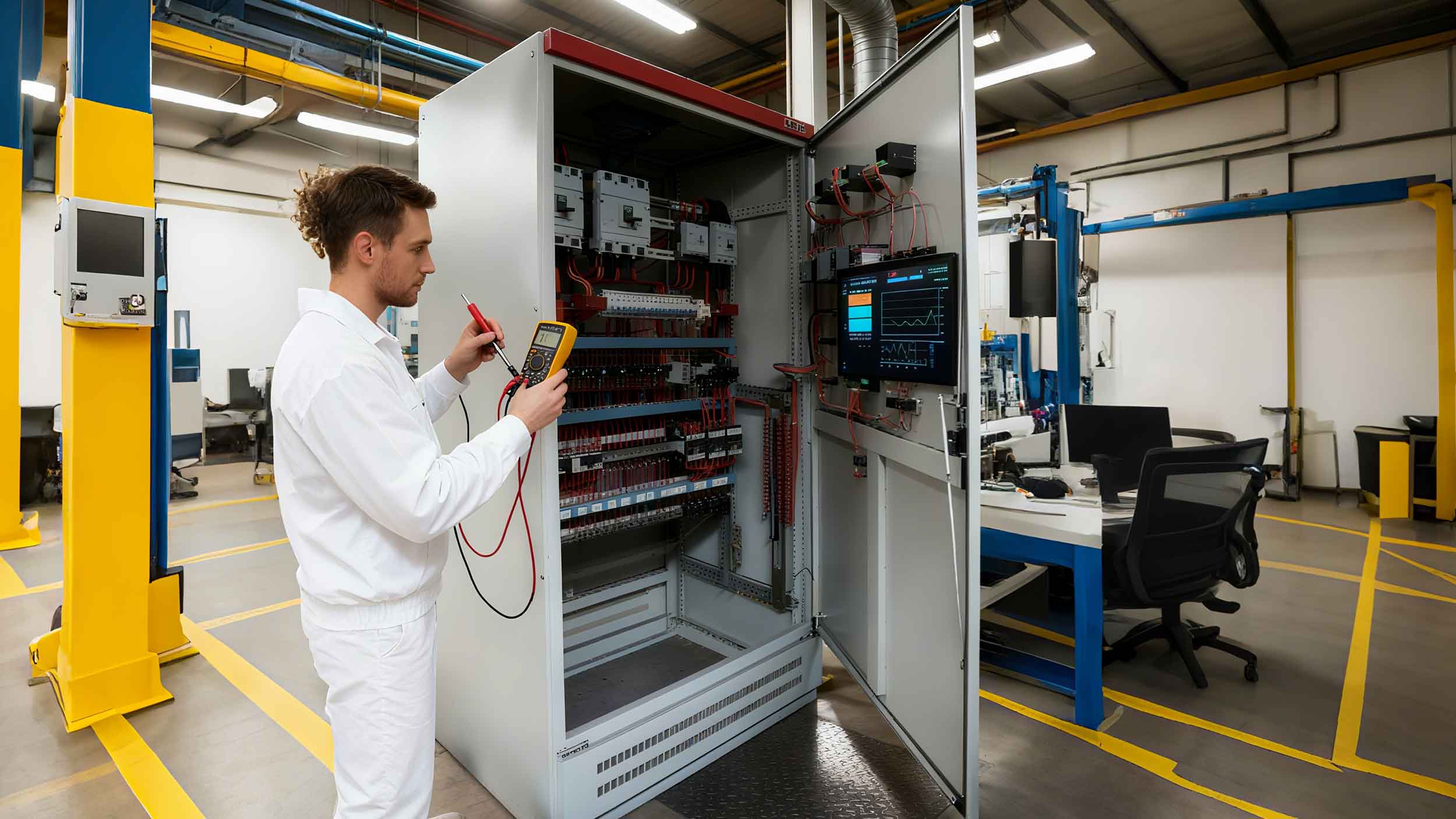
- Electrical System Inspection: Conduct power-on tests on PLC control systems and frequency conversion speed regulation systems to verify the accuracy of parameter adjustment (speed regulation error ≤±10r/min). At the same time, perform ground resistance testing (≤4Ω) and insulation resistance testing (≥1MΩ) to ensure electrical safety;
- No-Load Trial Operation Inspection: After the assembly of the entire machine, a 4-hour no-load trial operation is conducted to detect equipment noise (≤75dB) and vibration velocity (≤2.8mm/s), while monitoring motor temperature rise (≤40K). Only when all indicators meet the standards can it enter the load test.
2.3 Full-Load Testing of Entire Machine: Performance Verification Under Simulated Real Working Conditions
- Particle Size Precision Testing: Use standard materials (such as quartz sand and calcium carbonate) for load testing, and detect the particle size distribution of crushed materials through laser particle size analyzers. The target particle size error is ≤±5%, and the coefficient of variation CV of particle size distribution is ≤10% to ensure stable crushing precision;
- Energy Consumption and Efficiency Testing: Record energy consumption data of the equipment under different production capacities to ensure that the unit energy consumption is 15-20% lower than the industry average (e.g., energy consumption ≤80kWh for processing 1 ton of quartz sand to 5μm); at the same time, detect the processing efficiency of the equipment to ensure it is within ±5% of the rated capacity;
- Continuous Stability Testing: Conduct a 72-hour continuous full-load operation test, recording equipment operation parameters (rotational speed, temperature, noise, particle size) every 8 hours. Qualification is defined as no fault shutdown and no obvious parameter drift, verifying the long-term operation stability of the equipment.
2.4 Final Delivery Inspection: Data Archiving and Traceability
Before each equipment leaves the factory, a “Quality Inspection Report” must be compiled, covering the test data of 12 core indicators. At the same time, a unique identification code is affixed to the equipment body to realize “one machine, one file” traceability. Customers can query the equipment’s test data, production batch, and component information through the identification code to ensure quality traceability.
3. Empowerment by Inspection Technology: Intelligent Equipment Improves Inspection Accuracy
To ensure the accuracy and objectivity of inspection results, JACAN has invested heavily in building a professional inspection laboratory and introducing world-leading inspection equipment, realizing “visual, data-driven, and intelligent” inspection:
- Particle Size Inspection Equipment: Adopt Malvern Mastersizer 3000 laser particle size analyzer with a detection range of 0.01μm-3500μm and particle size resolution ≤0.1μm, accurately capturing the particle size distribution of powder;
- Vibration and Noise Inspection Equipment: Use Bruckner vibration analyzers and Danish B&K sound level meters to real-time monitor the vibration frequency and noise decibels of equipment during operation, with data accuracy up to ±0.1dB;
- Energy Consumption Inspection Equipment: Adopt high-precision power analyzers (error ≤±0.2%) to record the energy consumption data of equipment under different working conditions, providing data support for energy consumption optimization;
- Intelligent Inspection System: Establish an inspection data management platform where all inspection data is uploaded and automatically analyzed in real-time to generate inspection reports. At the same time, potential quality risks are identified through big data comparison to optimize production processes in advance.
Conclusion: Forging Quality Trust with Rigorous Standards
“Comparable to German-Japanese quality” is not an empty slogan but JACAN’s 18-year unwavering adherence to inspection standards. From aligning with international advanced standards to layer-by-layer full-process inspection, to empowerment by intelligent inspection technology, every link demonstrates JACAN’s pursuit of ultimate quality.
It is this rigorous quality inspection standard that has enabled JACAN ultrafine grinders to gain the recognition of more than 1,200 global customers and achieve large-scale applications in industries such as minerals, lithium batteries, food, and pharmaceuticals. In the future, JACAN will continue to upgrade its inspection technology and standards, keep pace with the technological trends of international leading brands such as Germany and Japan, and continuously improve the precision, stability, and durability of equipment. It will make “Made in China” ultrafine grinders compete with German-Japanese brands on the global market.