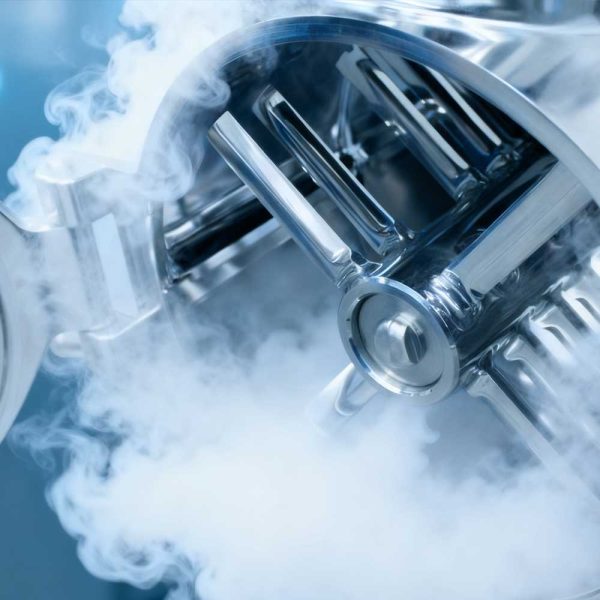
1. What is Cryogenic Grinding Technology? A Core Solution to “Thermosensitive Material Grinding Challenges”
Cryogenic grinding technology cools materials or the grinding environment to -40℃~-196℃ (adjusted based on material properties) using a refrigeration system. It leverages the physical characteristic of materials—increased brittleness and reduced toughness at low temperatures—and works with ultrafine grinding equipment to achieve efficient crushing. Compared with traditional room-temperature grinding, its core advantage lies in preventing thermosensitive and volatile materials from deteriorating due to high temperatures (e.g., loss of active ingredients in traditional Chinese medicine, melting and adhesion of rubber). Additionally, it improves the uniformity of material grinding particle size (up to below 10μm) and reduces dust pollution, making it a key technology for processing special materials in industries such as pharmaceuticals, food, and chemical engineering.
Core Principle: 3 Steps to Achieve “Low-Temperature + Efficient Grinding”
- Pre-cooling: Rapidly cool materials to below their glass transition temperature using a liquid nitrogen refrigeration or compression refrigeration system, rendering them inelastic;
- Low-Temperature Crushing: Cooled materials enter the ultrafine grinding chamber, where they are impacted and sheared by high-speed rotating blades/hammerheads. Due to increased brittleness, the materials are easily crushed without generating high temperatures;
- Separation and Collection: Crushed materials are separated via a low-temperature classification system to avoid caking caused by contact with room-temperature air, and finally, finished products meeting particle size requirements are collected.
2. 4 Core Application Scenarios of Cryogenic Grinding Technology (with Industry Cases)
1. Pharmaceutical Industry: Protecting Active Ingredients in Traditional Chinese Medicine/Biopharmaceuticals
- Application Objects: Thermosensitive traditional Chinese medicine (e.g., ginseng, antler), enzyme preparations, antibiotic raw materials;
- Technical Value: Prevents the loss of active ingredients (e.g., saponins, polysaccharides) in traditional Chinese medicine caused by high temperatures during room-temperature grinding, ensuring drug efficacy meets standards. For example, a traditional Chinese medicine enterprise used liquid nitrogen cryogenic grinding technology to process angelica, increasing the retention rate of active ingredients by 30% and achieving a finished product particle size uniformity of 95%.
- Equipment Requirements: Corrosion-resistant, low-temperature-adapted grinding chambers (e.g., 316L stainless steel) are required, and the tightness of the refrigeration system must be checked regularly (refer to the “component tightness inspection” in “regular maintenance” for ultrafine grinders).
2. Food Industry: Enhancing Grinding Quality of High-Oil/High-Sugar Materials
- Application Objects: Chocolate, nut butters, freeze-dried fruit and vegetable powders;
- Technical Value: Solves the problem of adhesion and caking when grinding high-oil materials (e.g., peanuts) at room temperature, while preserving the original flavor of food. For instance, a snack enterprise produced freeze-dried strawberry powder using cryogenic grinding technology, resulting in non-caking products with a fine texture and a 6-month extension of shelf life.
- Maintenance Points: Residual materials in the grinding chamber must be cleaned promptly after operation (refer to the “cleaning and dust removal” step in “daily maintenance” for ultrafine grinders) to prevent sugar from caking at low temperatures and blocking the equipment.
3. Rubber/Plastic Industry: Enabling Recycling of Waste Materials
- Application Objects: Waste tires, plastic films, special rubber;
- Technical Value: Rubber and plastics exhibit increased brittleness at low temperatures, allowing them to be ground into fine powder (e.g., tire powder used for asphalt modification) without material aging caused by high temperatures during room-temperature grinding.
- Special Maintenance: Strengthen inspections of the grinding chamber insulation layer (once per quarter, referring to the “regular maintenance” cycle for ultrafine grinders) to prevent cold loss from affecting grinding efficiency.
4. Chemical Industry: Processing Flammable, Explosive, or Volatile Materials
- Application Objects: Epoxy resin, pesticide technical materials, thermosensitive pigments;
- Technical Value: The low-temperature environment lowers the ignition point of flammable and explosive materials, avoiding safety accidents caused by frictional heat during grinding. It also reduces the loss of volatile components (e.g., active ingredients in pesticides).
- Safety Requirements: Regularly test the refrigeration system pressure and motor insulation performance (once per year, in line with the “annual maintenance” standards for ultrafine grinders) to ensure safe equipment operation.
3. 2025 Cryogenic Grinding Technology Trends: 3 Directions Leading Industry Upgrading
1. Intelligent Upgrading: AI + Cryogenic Grinding for “Precise Temperature Control + Automatic Maintenance”
- Trend Characteristics: Real-time monitoring of material temperature and grinding particle size via sensors, with AI systems automatically adjusting refrigeration temperature and grinding speed; equipped with equipment status early warning functions to automatically remind of maintenance needs such as “refrigeration system filter replacement” and “lubricating oil replenishment” (extending the “operation monitoring” intelligence of ultrafine grinders).
- Application Case: After introducing an AI cryogenic grinding production line, a chemical enterprise reduced equipment failure downtime by 40% and increased material grinding qualification rate to 98%.
2. Energy Conservation and Environmental Protection: Low-Energy Refrigeration Technology Becomes Mainstream
- Trend Characteristics: Traditional liquid nitrogen refrigeration has high costs; by 2025, more “compression refrigeration + waste heat recovery” technologies will be adopted to reduce energy consumption (saving over 25% compared to traditional solutions); meanwhile, new thermal insulation materials will be used in grinding chambers to reduce cold loss.
- Industry Significance: Aligns with the “dual carbon” policy requirements, helps enterprises reduce production costs, and promotes the popularization of cryogenic grinding technology in small and medium-sized enterprises.
4. Cryogenic Grinder Maintenance: 4 Key Points to Extend Equipment Service Life by 30%
Due to the inclusion of a refrigeration system, cryogenic grinder maintenance requires focusing on the following 4 points in addition to the basic maintenance (cleaning, lubrication, fastening) of ultrafine grinders:
- Refrigeration System Maintenance: Check the refrigeration unit pressure regularly every week, clean dust from the condenser monthly, and replace the refrigeration system filter quarterly to prevent reduced refrigeration efficiency due to poor heat dissipation;
- Low-Temperature Component Maintenance: Inspect the grinding chamber insulation layer for damage every six months, repair cracks promptly if found to prevent cold loss; at the same time, regularly check low-temperature seals (e.g., O-rings) and replace them when aged (avoid using ordinary seals as substitutes; low-temperature-adapted materials must be selected);
- Lubrication Adaptation: Use low-temperature lubricating oil (pour point below -50℃) for rotating components (e.g., main shaft, bearings) to prevent room-temperature lubricating oil from solidifying at low temperatures and causing component wear (refer to the “special lubricating oil” requirement in “lubrication inspection” for ultrafine grinders);
- Shutdown Protection: Before long-term shutdown, drain the coolant in the refrigeration system and clean residual materials in the grinding chamber to prevent materials from freezing at low temperatures and damaging equipment components.
5. Conclusion: Cryogenic Grinding Technology Ushering in a New Era of “Special Material Grinding”
As industries such as pharmaceuticals and food raise requirements for material quality, cryogenic grinding technology will become a key factor for enterprises to enhance core competitiveness. Mastering its technical principles, application scenarios, and equipment maintenance points not only ensures production efficiency and product quality but also keeps pace with the 2025 industry trends of intelligence, energy conservation, and environmental protection. It is recommended that enterprises select suitable refrigeration solutions based on their material properties when introducing cryogenic grinding equipment and develop scientific maintenance plans (which can refer to the maintenance cycle of ultrafine grinders and be adjusted according to the characteristics of low-temperature equipment) to maximize the technical value.