In many industrial fields such as mineral processing, pharmaceutical, food, fine chemical, and new energy, the precision of powder materials directly determines product quality, production efficiency, and market competitiveness. With the increasing demands of emerging industries for powder particle size distribution and purity, traditional single-stage classification technology has been difficult to adapt to large-scale and refined production needs due to its shortcomings such as limited precision, low classification efficiency, and insufficient production capacity. The emergence and iteration of classifier multi-stage separation technology have completely broken this bottleneck. Relying on the core logic of “layer-by-layer screening and precise classification”, it has become a key core solution to improve powder precision and optimize production efficiency, promoting the transformation of the powder processing industry towards high efficiency and refinement.
I. Prominent Industry Pain Points, Multi-Stage Separation Technology Emerges as the Times Require
Powder classification is a core link in the powder processing process. Its purpose is to accurately separate the crushed mixed powder into finished products of different specifications according to particle size, remove impurities and unqualified particles, and ensure powder uniformity. At present, traditional single-stage classification technology faces many pain points in practical application, which seriously restrict the development of the industry:
First, insufficient classification precision. Single-stage separation can only realize simple division of coarse and fine powder, making it difficult to control the powder particle size distribution range. It is prone to the problem of “coarse powder entraining fine powder and fine powder mixing into coarse powder”, resulting in low finished product purity, which cannot meet the production requirements of high-end products. For example, the error requirement of powder D50 particle size in new energy battery materials, precision pharmaceutical and other fields needs to be controlled within ±5μm; Second, low classification efficiency. The processing capacity of single-stage equipment is limited, and repeated classification is required to achieve the expected precision, which not only increases energy consumption but also prolongs the production cycle. According to industry statistics, the efficiency of traditional single-stage classifiers is generally less than 80%, while the efficiency of multi-stage separation technology can exceed 92%; Third, narrow applicability. Faced with special powders with strong viscosity, high agglomeration, and uneven hardness, single-stage classification is prone to equipment blockage, severe wear of classification wheels, and high maintenance costs; Fourth, it is difficult to balance production capacity and precision. If a single-stage classifier pursues high precision, it needs to reduce the processing capacity; if it increases the production capacity, it will sacrifice precision, which cannot adapt to the needs of large-scale refined production.
In response to the above pain points, classifier multi-stage separation technology relies on the design concept of multi-unit series connection and gradient classification, realizing a triple breakthrough in “precision, efficiency, and production capacity”. It has become the optimal path to solve the problem of powder classification, and also conforms to the current development trend of the air classifier market with a compound annual growth rate of 8.3%, becoming the core technology upgrading direction of the powder processing industry.
II. Core Principle of Multi-Stage Separation Technology: Layer-by-Layer Progression, Precise Diameter Control
The core logic of classifier multi-stage separation technology is “classification unit series connection, gradient screening, and closed-loop regulation”. It integrates the advantages of self-splitting inertia classification technology and centrifugal classification technology. Through the cooperative work of multiple sets of classification wheels and classification chambers, the mixed powder is separated multiple times and gradiently, and finally, powder products with uniform particle size distribution and qualified purity are obtained. Its core working process and technical points are as follows:
1. Feeding Pretreatment: The crushed mixed powder is uniformly fed into the first-stage classification unit through the feeding system. At the same time, air conveying (or mechanical conveying) is used to ensure uniform powder dispersion and avoid agglomerated particles affecting classification precision. Especially for nano-micron powder, ultrasonic dispersion treatment is carried out in advance to lay the foundation for subsequent classification.
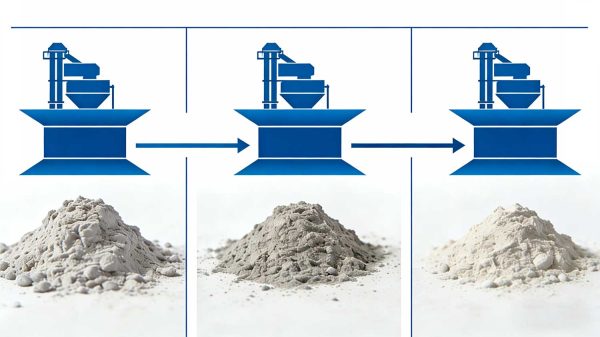
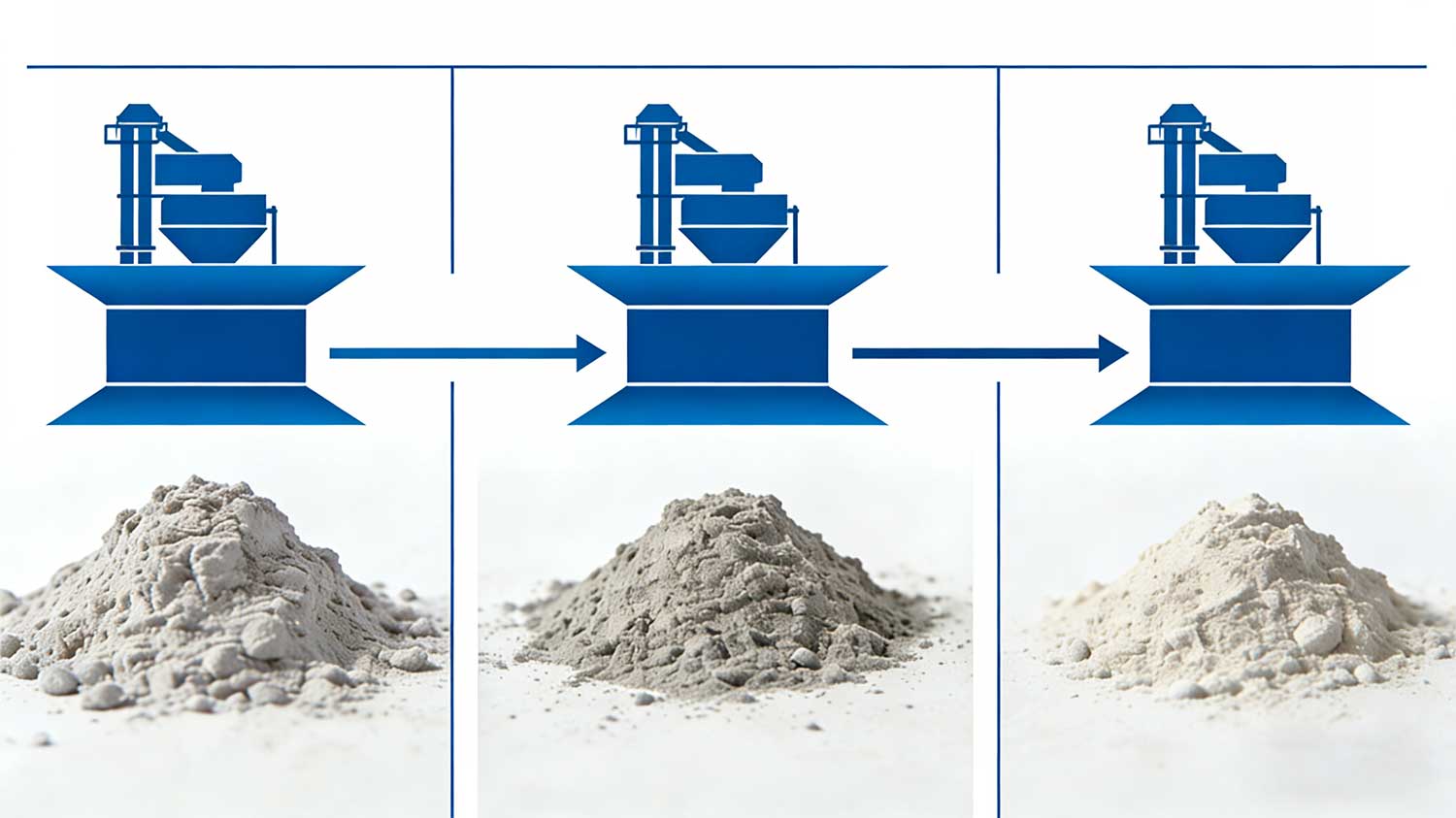
2. Gradient Classification Operation: The multi-stage separation system is usually equipped with 3-6 classification units (which can be adjusted according to actual needs). The classification wheel speed, air velocity, and classification chamber structure of each classification unit are set differently, showing a regulation logic of “gradient increase” or “gradient decrease”. Taking three-stage series classification as an example, the first-stage classification unit mainly focuses on coarse classification, separating impurity particles with excessive particle size, with a classification efficiency of more than 85%; the second-stage classification unit realizes medium classification, screening out medium-specification powder, with an efficiency of up to 90%; the third-stage classification unit focuses on fine classification, accurately separating fine powder that meets the requirements, with an efficiency as high as 95%, achieving precise diameter control step by step.
3. Closed-Loop Regulation and Optimization: Through the intelligent control system, real-time monitor the powder particle size, air velocity, classification wheel speed and other parameters of each classification unit, and automatically adjust the equipment operation status according to the monitoring data to form a closed-loop regulation of “monitoring-adjustment-optimization”. At the same time, some high-end equipment will introduce a viscosity gradient separation system, configure separation solutions with different viscosities, and combine gravity sedimentation and centrifugal separation to make the separation precision reach 50-100nm, completely eliminating coarse particle leakage.
4. Finished Product Collection and Tailings Treatment: The qualified powder separated by the last classification unit is collected through cyclone collectors, bag filters and other equipment to ensure powder purity; the tailings (unqualified powder) generated during the classification process can be re-conveyed to the crushing system for secondary crushing, and then returned to the classification system for re-classification, realizing resource recycling and reducing raw material waste. For example, in spodumene processing, the lithium element recovery rate can be increased from 82% to 90%.
Compared with traditional single-stage classification technology, multi-stage separation technology effectively solves the problems of insufficient precision and uneven particle size distribution of single-stage classification through “multiple classifications and precise regulation”. At the same time, through the cooperative work of classification units, it greatly improves classification efficiency and production capacity, realizing the dual balance of “high precision and high production capacity”. Its core advantage is that the speed of the classification wheel is 50% lower than that of traditional equipment, which not only reduces wear but also lowers energy consumption.
III. Core Advantages of Multi-Stage Separation Technology: Empowering Powder Processing to Improve Quality and Efficiency
Compared with traditional single-stage classification technology, classifier multi-stage separation technology has significant advantages in precision, efficiency, energy consumption, applicability, etc., which perfectly adapts to the current development needs of the powder processing industry for “refinement, high efficiency, and energy saving”, and becomes the key to improving the core competitiveness of enterprises. The specific advantages are as follows:
1. High Classification Precision and Uniform Particle Size Distribution: Through multi-stage gradient classification and closed-loop regulation, the powder particle size range can be accurately controlled. The particle size error of the finished powder can be controlled within ±3μm, and some high-end equipment can achieve nano-level separation, with narrow particle size distribution span and strong uniformity, which can meet the strict requirements of new energy, precision electronics, high-end pharmaceutical and other fields. For example, a leading pharmaceutical company used this technology to process antibiotic raw materials, narrowing the particle size distribution range from 10-150μm to 20-80μm, and increasing the product dissolution rate by 18%.
2. High Classification Efficiency and Significant Production Capacity Advantage: Multiple classification units work together without repeated classification. The classification efficiency is more than 40% higher than that of traditional single-stage technology, and the comprehensive classification efficiency can reach 92%-97%; at the same time, the production capacity of a single multi-stage classifier can be increased to 5t/h, 3 times higher than that of traditional equipment, which can adapt to large-scale production needs, greatly shorten the production cycle, and reduce production costs.
3. Low Energy Consumption, Green and Environmentally Friendly: Through intelligent closed-loop regulation and optimized design of classification units, energy waste caused by repeated classification is avoided. Under the same processing capacity, the energy consumption is 50% lower than that of traditional horizontal and vertical classifiers; at the same time, the equipment adopts a negative pressure production mode, no dust pollution, and combined with the tailings recycling design, realizes green and low-carbon production, which conforms to the current industrial environmental protection policy requirements.
4. Wide Applicability, Adapting to Diversified Powders: It can flexibly adapt to the classification of powders with different materials, different hardness, and different particle size requirements. Whether it is high-hardness silicon carbide, corundum, viscous food additives, Chinese herbal medicine powders, or nano-micron powders, it can achieve efficient classification; at the same time, it can be combined with various grinding equipment such as air jet mills, mechanical mills, and ball mills to form closed-circuit or open-circuit combined operations, meeting the diverse needs of laboratory small-batch research and development and industrial large-scale production.
5. Strong Stability and Low Maintenance Cost: The multi-stage separation equipment has a reasonable structure. Each classification unit works independently and is interrelated, reducing the impact of a single unit failure on the overall production; the classification wheel is designed with wear-resistant materials, and its service life is 5-8 times longer than that of traditional equipment. The equipment can run continuously for 72 hours without blockage, and the maintenance cycle is extended to 3 months, which greatly reduces equipment maintenance costs and downtime losses.
IV. Practical Application Scenarios of Multi-Stage Separation Technology: Covering Multiple Industries, Empowering High-Quality Development
With its significant technical advantages, classifier multi-stage separation technology has been widely used in mineral processing, pharmaceutical, food, fine chemical, new energy, electronic materials and other fields, becoming the core support for various industries to improve product quality and optimize production efficiency. The specific application cases are as follows:
1. Mineral Processing Field: In the processing of minerals such as quartz sand, kaolin, calcium carbonate, spodumene, and copper concentrate, multi-stage separation technology can accurately separate mineral powders, remove impurities, and improve the purity and whiteness of mineral powders. For example, a large copper mine used this technology to process copper concentrate, increasing the classification efficiency from 78% to 92%, with an annual increase of more than 2,000 tons of copper metal; in spodumene processing, the lithium element recovery rate can be increased by 8 percentage points, saving more than 5 million yuan in raw material costs annually.
2. Pharmaceutical Field: In the processing of antibiotics, Chinese medicine powders, health product powders, etc., multi-stage separation technology can accurately control the powder particle size, ensure powder uniformity, improve drug dissolution rate and efficacy, and avoid impurity mixing to ensure drug safety. A leading pharmaceutical company used a multi-stage rotor air classifier to process antibiotic raw materials, increasing the batch qualification rate from 92% to 98%, and greatly improving product quality.
3. Food Field: In the processing of food powders such as starch, pollen, hawthorn powder, and vegetable powder, multi-stage separation technology can remove impurities and coarse particles in food powders, ensure that the powder is fine and uniform, improve food taste and quality, and avoid material wall sticking to reduce waste. For example, when a conical centrifugal multi-stage classifier processes starch, the production capacity reaches 3t/h, the energy consumption is reduced by 22%, and the equipment runs continuously without blockage.
4. New Energy Field: In the processing of new energy battery materials such as lithium iron phosphate, ternary materials, and graphite, multi-stage separation technology can accurately control the powder particle size, improve the compaction density and energy density of battery materials, and help upgrade the performance of new energy batteries. A leading battery material enterprise used this technology to process lithium iron phosphate precursor, accurately adjusting D50 from 5μm to 3μm, and increasing the battery energy density by 8%.
5. Other Fields: In the fine chemical field, it can be used for the classification of powders such as aluminum hydroxide, silica gel, and dyes to ensure stable product performance; in the electronic materials field, it can be used for the precise classification of powders such as fluorescent powder and magnetic materials to ensure the performance of electronic components; in laboratory research and development, small multi-stage classifiers, with modular design, can be quickly disassembled and assembled, suitable for multi-variety and small-batch research and development, and the changeover time is shortened from 4 hours to 1 hour.
V. Technology Upgrade Trend: Intelligence, Customization, Adapting to Wider Needs
With the continuous development of the powder processing industry and the increasing demands of emerging industries for powder precision, classifier multi-stage separation technology is upgrading towards “intelligence, customization, and multi-functionality” to further release technical value:
1. Intelligent Upgrade: Integrate the Internet of Things and big data technology to realize real-time monitoring, remote regulation, and fault early warning of equipment operation status, reduce manual intervention, and improve classification stability and consistency; at the same time, optimize classification parameters through AI algorithms to realize “on-demand classification”, adapt to the classification needs of powders of different batches and materials, and promote the transformation of classification technology from “automation” to “intelligence”.
2. Customized Adaptation: According to the characteristics of different industries and different powders, customize exclusive multi-stage classification schemes, optimize the number of classification units, classification wheel materials, air flow parameters, etc. For example, for high-hardness powders, wear-resistant classification wheels are adopted; for viscous powders, the classification chamber structure is optimized to avoid blockage, meeting the personalized needs of various industries. At present, various types of multi-stage classification equipment such as vertical, rotor, and conical centrifugal have been formed, covering full-scenario applications.
3. Multi-Functional Integration: Integrate classification, impurity removal, drying, dispersion and other functions into one, reduce the powder processing process, and improve production efficiency; at the same time, develop small and portable multi-stage classification equipment to adapt to laboratory research and development, small-batch production and other scenarios, and further expand the technical application scope. At present, it has achieved full particle size coverage within 2-150μm, and the processing capacity can be flexibly adjusted according to needs.
VI. Conclusion: Multi-Stage Separation Technology, Leading the Powder Precision Revolution
Against the background of the transformation of the powder processing industry towards refinement, high efficiency, and greenization, classification precision has become a core factor determining product competitiveness. With the core advantage of “layer-by-layer progression and precise diameter control”, classifier multi-stage separation technology effectively solves many pain points of traditional classification technology, realizes the triple improvement of powder precision, efficiency, and production capacity, and becomes a key solution to improve powder quality.
From mineral processing to new energy, from pharmaceutical to food, the wide application of multi-stage separation technology not only promotes the product upgrading and industrial transformation of various industries but also injects strong momentum into the high-quality development of the powder processing industry. With the continuous intelligent and customized upgrading of technology, classifier multi-stage separation technology will continue to make breakthroughs, adapt to the wider needs of the industry, lead the powder precision revolution, and help more enterprises achieve quality and efficiency improvement and green development, and gain an advantage in the increasingly fierce market competition.