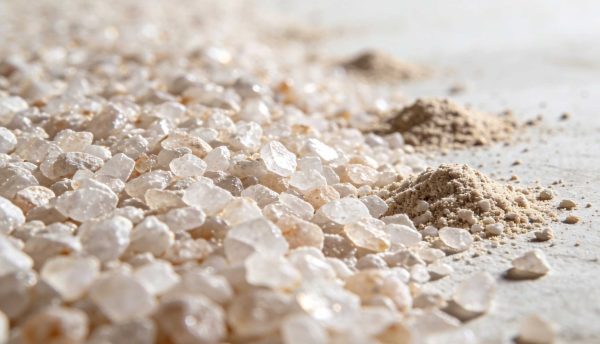
In the field of non-metallic mineral deep processing, quartz sand is widely used in high-end industries such as electronic semiconductors, photovoltaic glass, precision ceramics and coating fillers due to its high purity, low impurity content and strong chemical stability. The 5μm ultrafine quartz sand powder, as a core raw material for high-end manufacturing, imposes stringent requirements on the precision, purity and particle size distribution of the grinding process. Traditional grinding equipment is prone to problems such as uneven particle size, impurity introduction and powder agglomeration, making it difficult to meet the index requirements of high-end applications. Combining practical engineering cases, this paper shares a professional ultrafine grinding solution for processing quartz sand into 5μm powder, providing process reference and equipment selection ideas for mineral deep processing enterprises.
1. CORE TECHNICAL CHALLENGES OF GRINDING QUARTZ SAND INTO 5ΜM ULTRAFINE POWDER
With a Mohs hardness of 7, quartz sand is a high-hardness brittle mineral. Processing it into 5μm ultrafine powder requires breaking through four core technical challenges, which are also the key differences from conventional grinding:
Precise Particle Size Control: 5μm powder falls into the category of ultrafine powder, which requires accurate D50 compliance, no oversize large particles in D97, and a narrow particle size distribution to avoid uneven particle size affecting the performance of downstream products.
Zero-pollution Purity: High-end applications have extremely low requirements for the content of impurities such as iron and aluminum in quartz sand powder. It is necessary to avoid introducing metal impurities due to equipment wear during the grinding process and maintain high powder purity.
Powder Anti-agglomeration: Ultrafine powder has a large specific surface area and is prone to agglomeration. Dispersion must be achieved synchronously during the grinding process to ensure the fluidity and service performance of the powder.
High Efficiency and Low Energy Consumption: Ultrafine grinding of high-hardness minerals is prone to high energy consumption and low productivity. It is necessary to balance processing efficiency and production costs to meet the requirements of industrial mass production.
2. PRACTICAL CASE OF 5ΜM ULTRAFINE GRINDING OF QUARTZ SAND: PROCESS DESIGN AND EQUIPMENT CONFIGURATION
PROJECT BACKGROUND
A non-metallic mineral deep processing enterprise could only process quartz sand powder to a particle size of 20μm with its original equipment, which failed to meet the 5μm index requirement for photovoltaic glass fillers. In addition, the enterprise faced problems such as powder agglomeration and excessive iron impurities (iron content >50ppm). It was in urgent need of upgrading the ultrafine grinding process to achieve stable mass production of 5μm ultrafine powder while ensuring powder purity and particle size uniformity.
CORE SOLUTION: CLASSIFIER-TYPE JET MILL ULTRAFINE GRINDING PROCESS
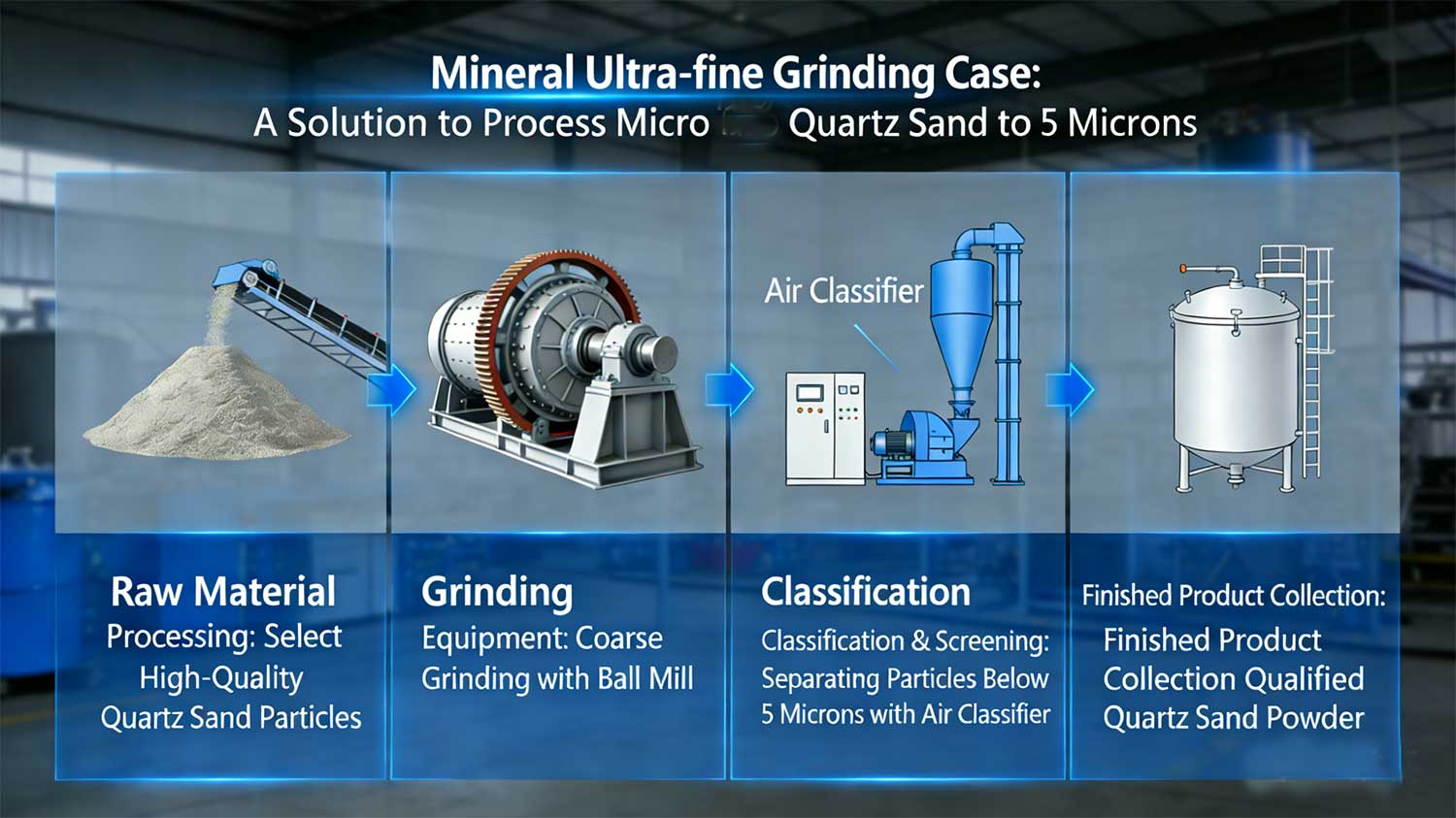
In view of the material characteristics of quartz sand and the 5μm processing requirements, an integrated process of “raw material pretreatment → coarse grinding → fine classification → ultrafine grinding → finished product collection” is adopted. The core equipment for ultrafine grinding is a classifier-type jet mill, matched with a precision air classifier and a dust-free collection system. From process design to equipment selection, the scheme comprehensively solves the problems of particle size control, purity maintenance and powder agglomeration, with the specific configuration as follows:
Raw Material Pretreatment: Magnetic separation for iron removal, drying for water removal (moisture content ≤0.5%) and screening for impurity removal are carried out on raw ore quartz sand to eliminate metal impurities and large particle sand and gravel in the raw materials, ensure the purity of the feed material and lay a foundation for subsequent grinding.
Coarse Grinding Stage: A jaw crusher and a Raymond mill are used to crush quartz sand into 200-mesh basic powder, reducing energy consumption and improving processing efficiency in the ultrafine grinding stage.
Core Ultrafine Grinding Stage: A classifier-type jet mill is selected. Utilizing the supersonic jet generated by high-pressure air flow, quartz sand particles collide, impact and shear at high speed to realize grinding. The equipment is built-in with a precision classifying wheel for real-time classification and screening, accurately controlling the particle size at 5μm. Meanwhile, the equipment adopts ceramic lining and wear-resistant alloy components to avoid introducing metal impurities from the source and ensure powder purity.
Dispersion and Collection Stage: The ground powder is collected in a dust-free way through a cyclone separator and a bag filter, and an air dispersion device is configured synchronously to break powder agglomeration and ensure the fluidity of the finished powder. The finally collected 5μm quartz sand powder meets the D50 standard accurately, has no oversize particles in D97 and its iron content is ≤30ppm, satisfying the standards of high-end applications.
PROJECT OPERATION EFFECT
After the implementation of this process scheme, the industrial stable mass production of 5μm ultrafine quartz sand powder has been realized, with the daily output of qualified powder reaching 5-8 tons. Compared with traditional equipment, the productivity has increased by 3 times and energy consumption has reduced by 25%. The finished powder features a narrow particle size distribution (D50=5μm±0.5μm) and no oversize large particles, with the iron impurity content controlled within 30ppm. Its purity fully meets the application requirements of high-end fields such as photovoltaic glass and electronic semiconductors, helping the enterprise successfully enter the high-end non-metallic mineral powder market and improve product added value and market competitiveness.
3. KEY EQUIPMENT SELECTION POINTS FOR 5ΜM ULTRAFINE GRINDING OF QUARTZ SAND
Equipment is the core of achieving precise 5μm grinding. In view of the high hardness and high purity requirements of quartz sand, three core principles must be followed for equipment selection to avoid process problems caused by improper selection:
Prioritize Classifier-type Jet Mill: Compared with traditional equipment such as ball mills and rod mills, jet mills adopt the air flow grinding principle without contact with mechanical grinding media, which can effectively avoid impurity introduction. The built-in classifying wheel enables integrated “grinding + classification” and precise particle size control, making it the first choice for grinding 5μm ultrafine quartz sand.
Focus on Equipment Wear and Pollution Prevention Design: The equipment lining should be made of high-hardness, impurity-free and wear-resistant materials such as ceramics and polyurethane, and the easily worn parts should be made of wear-resistant alloys to eliminate metal wear introduction from the source and ensure high powder purity.
Match with Precision Classification and Dust-free Collection System: Independent grinding cannot ensure uniform particle size. It is necessary to match with a high-precision air classifier to screen out unqualified large particles in real time and return them to the grinding system. At the same time, a closed dust-free collection system is configured to not only ensure the compliance of the production environment, but also avoid secondary pollution and agglomeration of powder during the collection process.
4. EXTENDED APPLICATION OF THE ULTRAFINE GRINDING PROCESS: ADAPTING TO THE PROCESSING OF VARIOUS NON-METALLIC MINERALS
The process scheme for 5μm ultrafine grinding of quartz sand is not only applicable to quartz sand. Its core design ideas can be extended to the ultrafine grinding processing of various non-metallic minerals such as calcium carbonate, talcum powder, kaolin, mica and silica powder. By fine-tuning equipment parameters and process configuration according to the hardness, moisture content and particle size requirements of different minerals, precise processing of 2-10μm ultrafine powder can be realized. The scheme is widely applicable to the raw material requirements of various industries such as coatings, plastics, rubber, electronics and new energy, providing a standardized and replicable ultrafine grinding solution for non-metallic mineral deep processing enterprises.
5. CONCLUSION
Processing quartz sand into 5μm ultrafine powder is an inevitable demand of high-end manufacturing for non-metallic mineral raw materials. Its core lies not in simple equipment upgrading, but in the optimization of the entire process chain of “raw material pretreatment – precise grinding – fine classification – dust-free collection”. Through the classifier-type jet mill integrated process, this case has successfully solved the core problems of particle size control, purity maintenance and powder anti-agglomeration in the ultrafine grinding of quartz sand, realized the stable mass production of 5μm powder and provided a feasible reference scheme for the industry.
For non-metallic mineral deep processing enterprises, to enter the high-end powder market, it is necessary to select professional ultrafine grinding equipment and customized process schemes according to their own material characteristics and product index requirements, rather than blindly following the trend of equipment selection. Professional process design plus adapted equipment configuration can not only ensure the compliance of powder indicators, but also achieve the goals of high efficiency, low consumption and mass production, helping enterprises improve product added value and gain advantages in the competition of the high-end market.