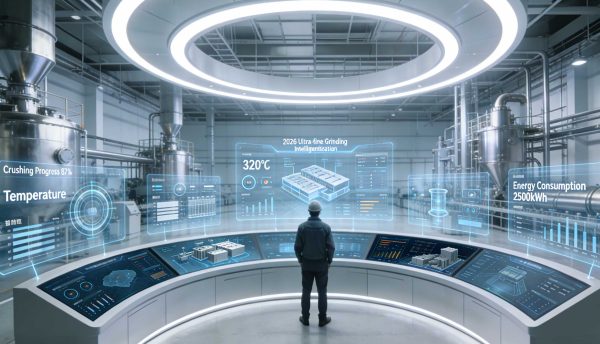
Driven by the rapid iteration of high-end industries such as new materials, new energy, and biomedicine, ultrafine grinding technology, as a core support for fields including non-metallic mineral deep processing, fine chemicals, and lithium battery material preparation, is undergoing a fundamental transformation from “extensive processing” to “precision intelligent manufacturing”. In 2026, with the in-depth integration of technologies such as artificial intelligence, the Internet of Things, and modular design with ultrafine grinding processes, intelligent upgrading and customization implementation have become the two core development mainlines. They not only solve industry pain points such as high energy consumption, low precision, and poor adaptability in traditional grinding processes, but also promote the ultrafine grinding industry towards high-end, efficient, and green development, providing more competitive raw material processing solutions for downstream high-end manufacturing industries.
The core value of ultrafine grinding technology lies in processing various minerals and materials into micron-level, submicron-level, or even nano-level powders. Its processing precision, powder purity, and production efficiency directly determine the performance and added value of downstream products. In the past, traditional ultrafine grinding equipment relied heavily on manual operation, with problems such as insufficient particle size control precision, high equipment operation and maintenance costs, and difficulty in adapting to the processing of multiple types of materials. Especially in the field of non-metallic mineral deep processing such as quartz sand, graphite, and calcium carbonate, it could not meet the strict requirements of high-end applications for powder indicators. In 2026, the in-depth penetration of intelligent and customized technologies is reconstructing the development pattern of the ultrafine grinding industry, becoming a key starting point for enterprises to break through production bottlenecks and enhance market competitiveness.
I. Core Trend 1 of Ultrafine Grinding Technology in 2026: Intelligent Upgrade, from “Manual Operation” to “Intelligent Manufacturing”
In 2026, the intelligent upgrade of ultrafine grinding technology is no longer a single equipment automation transformation, but an integrated upgrade to achieve “full-process intelligent control, full-lifecycle operation and maintenance, and full-data precise optimization”. Relying on AI algorithms, IoT sensors, digital twins, and other technologies, it makes ultrafine grinding production more efficient, precise, and energy-saving, which is also the core direction of current industry technological iteration.
1. Full-process Intelligent Control, Precisely Grasp Every Processing Link
In the traditional ultrafine grinding process, links such as particle size control, energy consumption adjustment, and impurity removal rely heavily on manual experience, which is prone to problems such as large particle size fluctuation, powder agglomeration, and excessive impurities. Especially in the processing of ultrafine powders below 5 microns, precision errors often affect the quality of downstream products. In 2026, intelligent ultrafine grinding production lines will become mainstream. By installing high-precision sensors in every link including raw material pretreatment, grinding, classification, and collection, core data such as material humidity, particle size distribution, equipment speed, and energy consumption are collected in real time and transmitted to the central control system for analysis and processing.
Relying on AI algorithms, the system can automatically adjust equipment parameters — for example, when detecting excessive moisture content in raw materials, it automatically increases the drying temperature and extends the drying time; when finding that the powder particle size is too coarse, it adjusts the jet mill pressure and classifier speed in real time, controlling the particle size fluctuation within ±0.3μm to ensure that key indicators such as D50 and D97 meet the standards accurately; for the grinding of high-hardness minerals such as quartz sand, the system can optimize the impact force and grinding time in real time according to the material hardness, which not only improves grinding efficiency but also reduces equipment wear. This full-process intelligent control not only reduces manual intervention by more than 30%, but also increases the batch consistency of powder products to 99.5%, greatly reducing the unqualified product rate.
2. Intelligent Operation and Maintenance and Fault Early Warning, Reduce Production Shutdown Losses
Ultrafine grinding equipment is mostly large-scale complete sets of equipment. Core components such as classifiers, grinding chambers, and air nozzles are prone to wear. The traditional operation and maintenance mode is mostly “post-fault maintenance”, which not only has high maintenance costs but also easily leads to long-term shutdown of the production line, affecting production capacity. In 2026, intelligent ultrafine grinding equipment will generally be equipped with predictive maintenance modules. Through IoT technology, it can real-time monitor the equipment operation status, collect data such as equipment vibration, temperature, and noise, and combine historical operation and maintenance data to predict the wear cycle and potential faults of core components through AI algorithms.
When there is an abnormal hidden danger in the equipment, the system will issue an early warning signal in a timely manner and push the specific fault location and maintenance suggestions. It can even realize remote operation and maintenance — engineers can diagnose equipment faults and adjust equipment parameters through the cloud platform without arriving at the production site, reducing unplanned shutdown time by more than 60%. At the same time, the intelligent system can automatically record equipment operation data and generate operation and maintenance reports, providing data support for enterprises to optimize production plans and reduce operation and maintenance costs. For example, by analyzing equipment energy consumption data and optimizing the grinding process, the overall energy consumption can be reduced by 15%-20%, which is in line with the green production demand under the dual carbon goal.
3. Digital Twin Empowerment, Realize Process Optimization and Simulation
In 2026, digital twin technology will be gradually applied to the ultrafine grinding industry. By building a digital twin model of the ultrafine grinding production line, it simulates the entire process of raw material pretreatment, grinding, classification, and collection, realizing virtual debugging and optimization of process parameters. Enterprises can debug parameters such as grinding pressure, classifier speed, and drying temperature for the characteristics of different materials (such as quartz sand, graphite, and traditional Chinese medicine raw materials) in a virtual scene, simulate the production effect under different parameters, and find the optimal process plan without actual production tests, which greatly shortens the new product R&D cycle and reduces R&D costs.
For example, for the demand of processing quartz sand into ultrafine powder of 5 microns, the operation status of the jet mill can be simulated through the digital twin model, and parameters such as air velocity and classifier speed can be optimized to avoid problems such as uneven particle size and agglomeration in actual production; for the ultrafine grinding of active ingredients of traditional Chinese medicine, low-temperature grinding parameters can be optimized through virtual simulation to ensure that the retention rate of active ingredients exceeds 95%, solving the industry pain point of grinding heat-sensitive materials. The application of digital twin technology will transform the ultrafine grinding process from “experience-driven” to “data-driven”, further improving production efficiency and product quality.
II. Core Trend 2 of Ultrafine Grinding Technology in 2026: Customization Implementation, from “General Processing” to “Precise Adaptation”
With the diversified development of downstream high-end manufacturing industries, the demand for ultrafine powder indicators varies significantly among different industries and products — for example, the photovoltaic glass field requires high purity, narrow particle size distribution (about 5 microns), and low iron impurities (≤30ppm) for quartz sand powder; the lithium battery anode field requires high sphericity, suitable particle size, and good dispersibility for graphite powder; the biomedicine field requires low-temperature grinding and retention of active ingredients for traditional Chinese medicine powder; the food field requires equipment to meet hygiene standards to realize the ultrafine processing of materials such as collagen peptide powder.
Traditional general-purpose ultrafine grinding equipment can no longer meet this differentiated demand. In 2026, customization will become another core development trend of ultrafine grinding technology. Enterprises will provide integrated customized solutions from process design, equipment customization to after-sales service around “material characteristics + downstream demand”, realizing “one machine, one process, one product, one plan”, which is also a key breakthrough point for enterprises to enhance core competitiveness.
1. Material Customization: Exclusive Grinding Solutions Adapted to Different Material Characteristics
Different materials have different requirements for hardness, moisture content, brittleness, and purity, so the corresponding ultrafine grinding processes and equipment also need differentiated design. In 2026, ultrafine grinding enterprises will customize exclusive grinding solutions and equipment according to the characteristics of different materials — for example, for high-hardness minerals such as quartz sand and corundum (Mohs hardness above 7), customize classifier-type jet mills equipped with ceramic linings and wear-resistant alloy components to avoid introducing metal impurities due to equipment wear, and optimize impact force and classification precision to realize stable mass production of ultrafine powder below 5 microns, ensuring powder purity and particle size uniformity; for soft minerals such as graphite and talcum powder, customize low-impact and anti-agglomeration ultrafine grinding equipment, combined with air dispersion devices to break powder agglomeration and ensure powder fluidity; for heat-sensitive materials such as traditional Chinese medicine and probiotics, customize low-temperature ultrafine grinding equipment equipped with liquid nitrogen deep cooling system or cooling closed-circuit circulation system to control the grinding temperature within a low-temperature range, avoid material oxidation and deterioration, and increase the wall-breaking rate to more than 98% to retain material active ingredients.
In addition, for materials with high purity requirements (such as quartz sand used in the electronic semiconductor field), the customized solution will also integrate multi-level impurity removal processes, including magnetic separation for iron removal, precision screening, and pickling purification, to control the iron impurity content below 20ppm, meeting the purity requirements of high-end applications; for solid waste resource utilization, customize special grinding processes to realize ultrafine grinding and recycling of materials such as fly ash and construction waste, which is in line with the direction of environmental protection policies.
2. Demand Customization: Precise Index Adaptation to Downstream Industries
The product upgrading of downstream industries has increasingly strict requirements for ultrafine powder indicators. In 2026, the customization of ultrafine grinding will further focus on downstream demand to achieve “precise adaptation” — for example, for the demand of photovoltaic glass fillers, customize the 5-micron ultrafine grinding solution for quartz sand, strictly control the particle size distribution (D50=5μm±0.5μm), ensure the light transmittance and dispersibility of the powder, and improve the photoelectric conversion efficiency of photovoltaic glass; for the demand of lithium battery anode graphite processing, customize the graphite grinding and shaping solution to process graphite particles into suitable particle size, and increase the sphericity to ≥0.85, optimize the compatibility between graphite and electrolyte, and meet the performance requirements of high compaction and excellent cycle of lithium battery anodes; for the precision ceramic field, customize the ultrafine powder grinding solution to control the powder particle size at 1-3 microns, ensuring the compactness and wear resistance of ceramic products; for the pharmaceutical industry, customize the traditional Chinese medicine ultrafine grinding solution to grind traditional Chinese medicine decoction pieces into submicron level, improve the dissolution rate of medicinal ingredients, enhance bioavailability, and conform to the development trend of traditional Chinese medicine modernization.
At the same time, in response to the demand for multi-variety and small-batch production, enterprises will launch a modular customization model of “core host + optional modules”. For example, jet mills can be flexibly configured with classification units, dust removal units, low-temperature modules, etc. Users can freely combine modules according to production capacity, material characteristics, and index requirements, which not only reduces equipment investment costs but also improves equipment adaptability, realizing “one equipment adapting to multiple materials and multiple index requirements”, which is suitable for the production characteristics and development needs of small and medium-sized enterprises.
3. Service Customization: Integrated Full-lifecycle Service from Equipment Delivery
In 2026, the customized service of ultrafine grinding will no longer be limited to the customization of processes and equipment, but will extend to “integrated full-lifecycle service”, including early demand research and process design, mid-term equipment manufacturing and installation and commissioning, and late-term operation and maintenance and process upgrading, to fully meet the production needs of enterprises. For example, enterprises can customize exclusive ultrafine grinding production lines according to the customer’s production capacity requirements (such as daily output of 5-8 tons of 5-micron quartz sand powder), existing production site, and budget investment, and be responsible for equipment installation and commissioning and personnel training to ensure the rapid commissioning of the production line; in the later production process, according to the customer’s product upgrading needs, provide process optimization and equipment upgrading services to help customers adapt to the index changes of downstream industries and improve product added value — a typical case of customized service is that a chemical enterprise optimized the D50 of titanium dioxide particle size from 35μm to 10μm by customizing a two-stage ultrafine grinder, increasing the product added value by 27%.
III. Integration of Intelligence and Customization, Promote High-quality Development of the Ultrafine Grinding Industry
In 2026, the intelligence and customization of ultrafine grinding technology are not independent of each other, but deeply integrated and developed collaboratively — intelligence provides technical support for customization, and customization endows application scenarios for intelligence. Together, they promote the transformation of the ultrafine grinding industry from “equipment manufacturing” to “solution provider”. For example, a customized ultrafine grinding production line can realize the rapid switching of different customized solutions by equipping an intelligent control system, adapting to the production needs of multiple varieties and multiple indicators; the production data collected by the intelligent system can provide support for the optimization of customized solutions, making the customized solutions more precise, efficient, and energy-saving.
This integration trend will not only solve the development pain points of the traditional ultrafine grinding industry but also promote the industry towards high-end, green, and diversified upgrading: in the field of non-metallic mineral deep processing, through intelligent + customized solutions, realize the mass production of high-end ultrafine powders such as quartz sand and graphite, helping enterprises enter high-end markets such as photovoltaic, electronic semiconductor, and lithium battery; in the biomedicine field, promote the modernization of traditional Chinese medicine and the development of high-end preparations through low-temperature intelligent customized grinding technology; in the field of solid waste resource utilization, realize the recycling of waste through customized intelligent grinding processes, which is in line with the dual carbon goal and the direction of environmental protection policies; in fields such as food and coatings, improve product quality and market competitiveness through precise customization and intelligent control.
IV. Enterprise Layout Suggestions for 2026: Keep Up with Trends and Seize the Opportunities of Intelligence and Customization
For ultrafine grinding equipment enterprises, 2026 is a key year for technological iteration and market competition. To gain an advantage in market competition, they need to keep up with the trends of intelligence and customization, focus on core technology R&D and service upgrading: first, increase investment in intelligent technology R&D, focus on the integration of technologies such as AI algorithms, IoT, and digital twins with ultrafine grinding processes, develop high-end equipment with intelligent control and intelligent operation and maintenance, reduce energy consumption and operation and maintenance costs, and improve production efficiency and product precision; second, deeply cultivate downstream industry needs, thoroughly understand the powder index requirements of different industries, create differentiated customized solutions, focus on segmented fields (such as lithium battery materials, traditional Chinese medicine grinding, and solid waste resource utilization), form core competitiveness, and avoid homogeneous competition; third, strengthen industrial chain collaboration, establish in-depth cooperation with upstream core component enterprises (such as sensor and AI chip enterprises) and downstream high-end manufacturing enterprises, open up the entire industrial chain of technology R&D, equipment manufacturing, and application implementation, and improve the adaptability and implementability of solutions; fourth, improve the customized service system, extend the service chain, provide integrated services from demand research to later operation and maintenance, enhance customer stickiness, and at the same time, rely on the cost performance and localized service advantages of domestic equipment to promote the localization replacement process of domestic ultrafine grinding equipment — at present, the market share of domestic equipment has increased from less than 20% in 2015 to more than 65% in 2022, and there is broad room for localization replacement in the future.